

I was reading the literature on lutein and zeaxanthin and their relationship with healthy aging, and it took me down a much more interesting path: what if some of the nutrients we keep searching for in supplements and imported “superfoods” are already sitting in foods our ancestors have been eating for generations?
Lutein and zeaxanthin are among the better-studied carotenoids for brain and eye health. They accumulate in neural tissue and the retina, and randomized trials have reported improvements in some measures of cognitive function, although the overall cognitive evidence is still mixed.
In people with intermediate age-related macular degeneration, the AREDS2 formulation containing lutein and zeaxanthin can reduce the risk of progression to advanced disease.
But this is where Genetic and Evolutionary Nutrition becomes particularly interesting. We should not only ask, “What nutrient is beneficial?” We should also ask, “Where has this nutrient historically existed in the food environment of the people we are studying?”
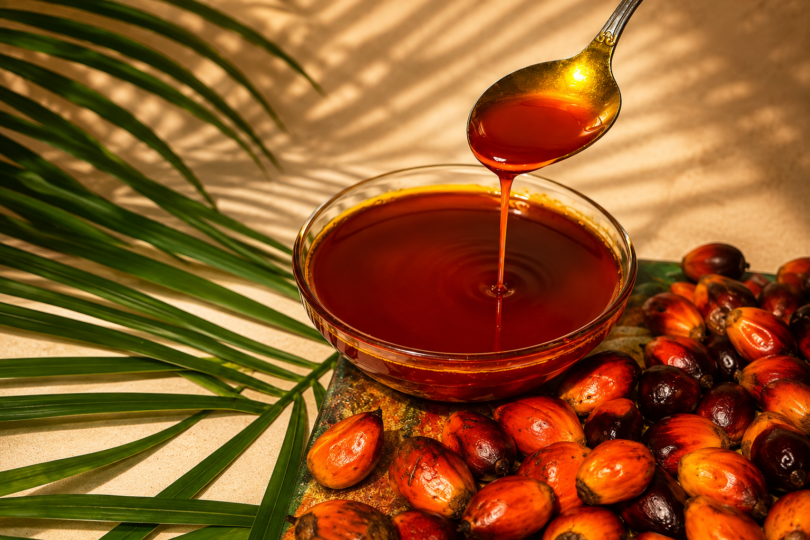
Traditional red/palm fruit oil (Elaeis guineensis) is exceptionally rich in carotenoids – particularly B-carotene and B-carotene- and also contains tocopherols and tocotrienols.
Reviews have reported carotenoid concentrations in red palm oil in the hundreds of mg/kg, with B- and β-carotene making up the major fractions. Human trials have also found that red palm oil can increase B-carotene and vitamin A status, and a meta-analysis of randomized trials found a reduced risk of vitamin A deficiency with red palm oil interventions.
So while kale, spinach and supplements containing lutein and zeaxanthin absolutely have their place, I find it intellectually lazy to assume that the answer to African nutrition must always be found somewhere else.
Our traditional palm fruit oil gives us a different carotenoid profile and a remarkable nutritional matrix that deserves much more serious investigation. And this is not an argument that palm fruit oil magically replaces lutein and zeaxanthin; it doesn’t. It is an argument for looking at the whole food rather than isolating one nutrient and declaring the capsule superior. In fact, with palm fruit oil, you gain more.
Evolutionary nutrition asks us to examine the foods, environments and dietary patterns within which populations developed over generations. For many West and Central African populations, palm fruit has been part of that ecological food environment for a very long time.

There is another myth we need to correct.
“PALM FRUIT OIL CAUSES CHOLESTEROL.”
That statement is far too simplistic. And that’s why and how many abandoned Ofe Akwu and its associated Banga Soup.
Palm fruit oil is relatively high in saturated fat, so it should not be treated as metabolically neutral or as an unlimited health food. But the scientific literature does not support the idea that consuming palm oil automatically causes cardiovascular disease. The effects on blood lipids depend considerably on what palm oil replaces in the diet. A systematic review of dietary intervention trials found both favorable and unfavorable lipid changes depending on the comparison fat, while another meta-analysis found no significant increase in total cholesterol, LDL cholesterol or triglycerides compared with unsaturated fats.
And this distinction matters enormously.
What are we comparing palm fruit oil with?
Palm fruit oil replacing trans fats is one question.
Palm fruit oil replacing highly unsaturated oils is another.
Palm fruit oil consumed as part of a traditional dietary pattern is another.
And palm fruit oil consumed alongside ultra-processed foods, excess calories, and refined carbohydrates is yet another.
Nutrition cannot be reduced to one ingredient and one laboratory number.
This is precisely why I believe traditionally produced red palm fruit oil deserves a renaissance, not a blind defense, but a scientific one.
For generations, our people extracted oil from the fruit of a tree that is indigenous to West Africa. It became part of our cooking, our soups, our sauces and our food culture. It is naturally colored by its carotenoids, carries fat-soluble nutrients, and is extraordinarily well integrated into many traditional African cooking systems.
That does not make every palm oil product on the market healthy.
There is a huge difference between genuine, traditionally produced red palm fruit oil and an industrially refined, deodorized, bleached, or adulterated product.
And this is where I want us to be human.
Stop adulterating palm fruit oil.
Stop mixing inferior oils into it and selling it as the real thing.
Stop introducing harmful or inappropriate chemicals into its production simply to increase yield, change its appearance, or make production cheaper.
If we are going to commercialize one of Africa’s most valuable traditional foods, let us not destroy the very nutritional qualities that make it valuable.
Let us improve hygiene.
Improve extraction.
Improve storage.
Improve quality control.
Test the oil.
Standardize production where appropriate.
But preserve its nutritional integrity.
Perhaps the future of African nutrition is not about abandoning everything our ancestors ate and replacing it with capsules, powders and imported “superfoods.”
Perhaps part of the future is learning to look again at what was already growing around us—with modern science in one hand and ancestral knowledge in the other.
Sometimes, the superfood is not something we need to discover.
It is something we need to stop destroying.