

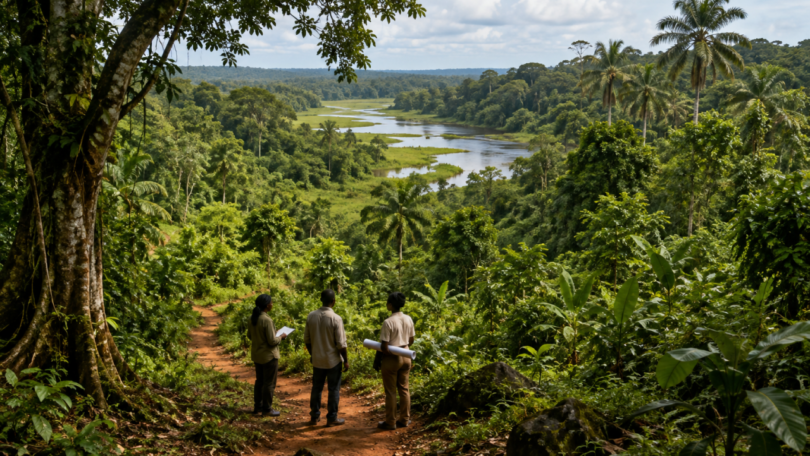

In my previous article, Building From the Ground Beneath Our Feet: Rethinking Construction in Liberia, I asked whether we might look more closely at the materials Liberia already has before automatically looking elsewhere for the materials with which to build. But there is another question that should come even earlier: Before we decide what to build with, how do we decide where and how to build?
When we imagine development, it is tempting to begin with the building. We picture the lodge, the school, the home, the road, or the new community and then search for a piece of land on which to place it. Too often, one of our first steps is to clear the land so that we can see the space and begin deciding where everything should go. But what if, in clearing the land first, we erase some of the very information we need to make those decisions wisely? Trees may show us where natural shade already exists. Vegetation may tell us where water collects. A natural clearing may provide space for a building without requiring the removal of mature trees. The slope of the land may reveal how rainwater moves during Liberia’s long rainy season. Wind, sunlight, wetlands, wildlife paths, and even the places where people naturally gather are all giving us information. Perhaps before we clear the land, we should listen to it.
Listening to the land begins with recognizing that land is not an empty space waiting for us to decide what to do with it. Long before the first tree is cleared or the first foundation is laid, the landscape is already functioning. Water moves through it. Trees stabilize soil and create shade. Plants establish themselves where conditions support them. Animals create pathways between habitats. Sunlight, wind, elevation, soil, and rainfall interact to create patterns that may not be obvious during a single visit. Landscape ecologists Richard Forman and Michel Godron described landscapes as interconnected systems rather than isolated pieces of land. When we begin to see the landscape this way, what we encounter is no longer simply something to clear or work around. It becomes information.
Learning to read that information requires something development projects do not always give themselves enough of: time. A piece of land visited during the dry season may tell a very different story after weeks of rain. A low area that appears ideal for construction may become a natural drainage route. A seemingly inconvenient group of trees may provide the best shade on the property. We need to walk the land, visit it at different times of day and, when possible, during different seasons. We can watch what happens when it rains, notice the direction of the breeze and movement of the sun, identify where water gathers and where it leaves, and sometimes simply sit and observe long enough to notice what hurried eyes might miss.
Listening to the land also means listening to the people who already know it. A farmer may know which areas remain waterlogged during the rains. A fisherman may understand changes occurring along an estuary. An elder may remember where a stream once flowed or where flooding occurred decades ago. People who gather plants may recognize what particular vegetation tells us about the soil. Architects, engineers, ecologists, soil specialists, and surveyors bring essential expertise, but professional knowledge does not have to replace local knowledge. The two can inform each other. Sometimes listening to the land means listening to the people who have been listening to it much longer than we have.
Once we have taken the time to understand a place, what we learn should begin to shape the design itself. In a 2022 interview with ArchDaily, Burkinabè architect Francis Kéré raised an important question: “How do you get inspired by these buildings to create something that relates to a given climate? This is the key. How do you do that, instead of copying?” His question shifts our attention away from what a building is supposed to look like and toward what a particular place requires of it. Nigerian architect Tosin Oshinowo approaches contextual design through another important idea: humility. “We must humble ourselves as designers to understand the context in which we’re working and provide the right solutions.” Together, their ideas suggest an approach particularly relevant to Liberia: understand the place rather than copy, and be humble enough to listen before deciding upon the solution.
Liberia needs homes, schools, roads, healthcare facilities, businesses, agricultural enterprises, tourism infrastructure, and communities in which people can prosper. Listening to the land is not an argument against development. It is an argument for building with greater understanding. Our heavy rainfall, tropical heat, forests, wetlands, rivers, estuaries, coastal areas, soils, and locally available materials present challenges, but they also provide information that can help determine how and where we build. Perhaps an existing clearing becomes the location of a building instead of clearing another section of forest. Perhaps a mature tree becomes the center of a gathering space rather than something removed to make room for one. Perhaps a building is repositioned to capture prevailing breezes and existing shade, or a wet area remains a wetland instead of being filled. Sometimes the land’s answer may simply be: Do not build here.
That does not mean development stops. It means we change the sequence. Listen. Learn. Design. Clear selectively. Build. We do not have to choose between leaving every piece of land untouched and clearing land indiscriminately in the name of progress. There is considerable space between those two extremes. We can build while protecting natural drainage, mature trees, wetlands, and wildlife habitat. The goal should not simply be to put buildings in nature. We can ask whether it is possible to design developments so that the habitat is better protected because the project exists.
This is what I mean when I use the phrase Land as the Teacher. It does not mean rejecting architecture, engineering, technology, or development. It means allowing these disciplines to enter into conversation with the landscape rather than assuming that the landscape must first be erased to accommodate them. Before the architect draws the first line, the land has already drawn its own—its waterways, slopes, tree lines, wetlands, clearings, and paths. Our responsibility is to learn how to read them. Perhaps the architect does not begin with the drawing after all.
The architect begins with the land.
In Liberia, development often begins with acquiring a piece of land, followed by what can seem like the obvious next step: clearing it. But what if clearing the land first removes some of the very information we need to decide what should be built there and where? In my latest article, I explore what it might mean to listen to the land before we clear, design, and build. The architect begins with the land.
#AfricanArchitecture #RegenerativeDevelopment
