



I can’t say coffee is my go-to beverage among the many options available on the market, even though it certainly stands out in the world of beverages and mood-enhancing drinks. Personally, I appreciate coffee more for its fine aroma than for its taste. I can manage coffee mixed with milk and honey, but I am sincerely not a fan of black coffee—my apologies to the diehard black coffee lovers.
Like almost everything in our world today, coffee has an origin story. It is one of those heartwarming beverages with a rich history that traces back to Ethiopia in East Africa.
A Short History of Coffee
No one knows exactly how or when coffee was discovered, although there are many legends surrounding its origin. Coffee grown around the world today can trace its heritage back centuries to the ancient coffee forests of the Ethiopian plateau.
According to legend, a goat herder named Kaldi first discovered the potential of coffee berries after noticing that his goats became unusually energetic after eating berries from a certain tree. They were so lively, the story goes, that they did not sleep at night.
Kaldi shared his discovery with the abbot of a local monastery, who made a drink from the berries and found that it helped him remain alert during long hours of evening prayer. The abbot then shared the discovery with the other monks, and knowledge of the energizing berries gradually began to spread.
As coffee moved eastward and reached the Arabian Peninsula, it began a journey that would eventually take it across the globe.
Ethiopia began exporting coffee around the 15th century. Somali merchants carried coffee to Yemen, where Sufi mystics drank it to help them remain alert and focused during long periods of chanting and prayer. A couple of centuries later, however, the Ethiopian Orthodox Church reportedly discouraged or banned its consumption for a period.
Coffee consumption in Ethiopia became widely accepted again in the late 19th century, particularly during the reign of Emperor Menelik II, who himself was said to be fond of the beverage.
From there, Ethiopia’s coffee production and exports continued to grow, and coffee became deeply connected to both the country’s economy and its culture. Millions of Ethiopians depend directly or indirectly on coffee for their livelihoods.
With the exception of a number of larger estates, much of Ethiopia’s coffee is still grown by small-scale farmers using traditional methods. Many cultivate what are often called “garden coffees” on small plots of land, sometimes measuring less than a hectare.
Ethiopia
Somehow, Ethiopia has become one of my favorite African countries, and that certainly was not the case before late 2018, when I first visited this beautiful country.
One of the first things that caught my attention, right at the airport, was the professional demeanor of the immigration officer who stamped my passport after asking only a few straightforward questions—quite different from some of my experiences at other airports.
You know how it can be when your passport is “green.” Sometimes, invisible antennas seem to go up almost immediately. But this officer appeared more interested in whether I knew where I was going in the capital, Addis Ababa, and whether I had the phone number of my host. I answered yes to both questions.
What struck me was that he seemed genuinely concerned about my safety rather than many of the unnecessary issues one sometimes encounters at airports. Then, with a big smile—as warm as a mug of coffee mixed with milk and honey—he said:
“Welcome to Ethiopia.”
Jebena Buna ceremony
The buna ceremony is a traditional, community-centered coffee ritual from Ethiopia and Eritrea in which green coffee beans are roasted, ground, and brewed by hand. The word buna or bunna means coffee in Amharic. As is often said, the buna ceremony is not designed for someone in a hurry. The preparation can be painstakingly slow. But I think slow is good for a great jebena buna—and perhaps for anything of real worth.
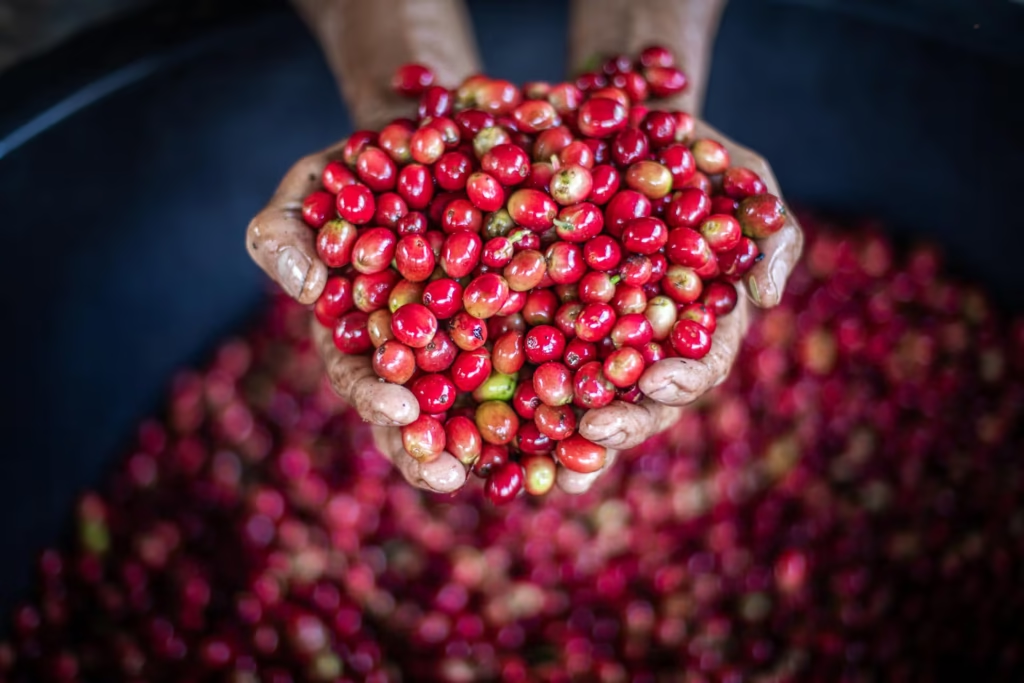
First, coffee cherries are picked when they are red and ripe, then peeled to expose the raw coffee beans. The host—traditionally the youngest woman in the family—heats water in a long-necked black clay pot over hot coals. This clay pot is known as a jebena. Hosting the coffee ceremony is considered an honor, and every step of the process, as well as every guest, is carefully attended to.
As the water begins to simmer, the host roasts the beans in a thin, open pan, stirring them constantly to ensure an even roast. How long the beans are roasted depends largely on the host. She may stop when they reach a light brown color, or continue until they become much darker and their natural oils begin to emerge.
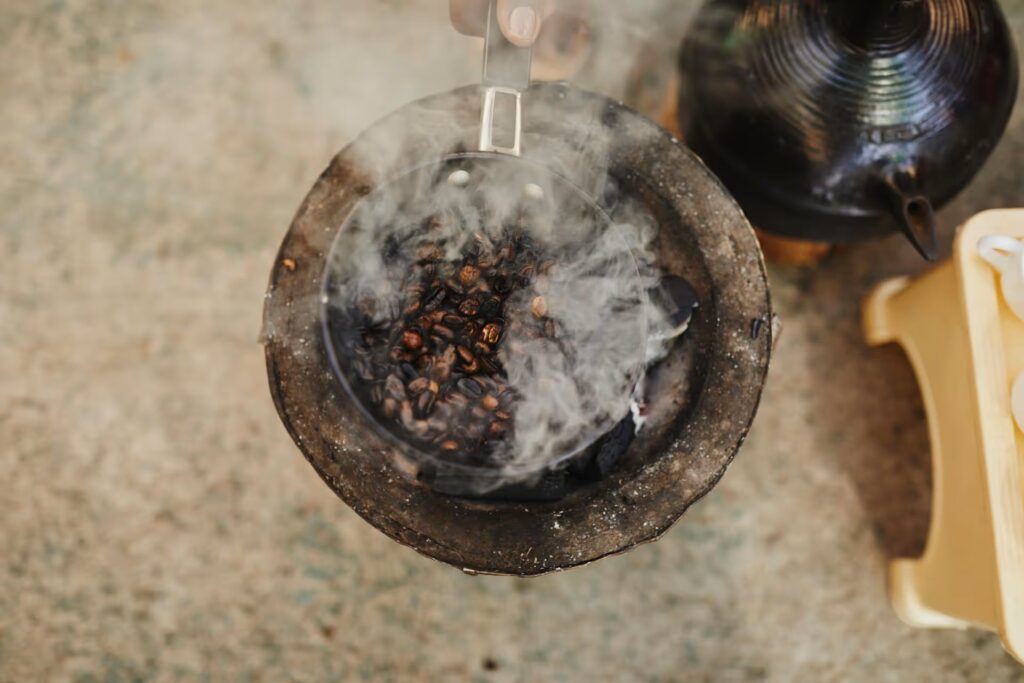
What follows is one of the most memorable parts of the ceremony.
The host carries the freshly roasted beans around to each guest so they can breathe in the rich aroma of the coffee. At the same time, incense is often burned, adding another layer of fragrance to the room. The scent of freshly roasted coffee mingling with incense becomes part of the experience itself.
Next, the roasted beans are ground into a fine powder in a thick wooden bowl called a mukecha, using a zenezena—a wooden or metal cylinder with a blunt end. Once finely ground, the coffee is added to the boiling water in the jebena and allowed to brew.
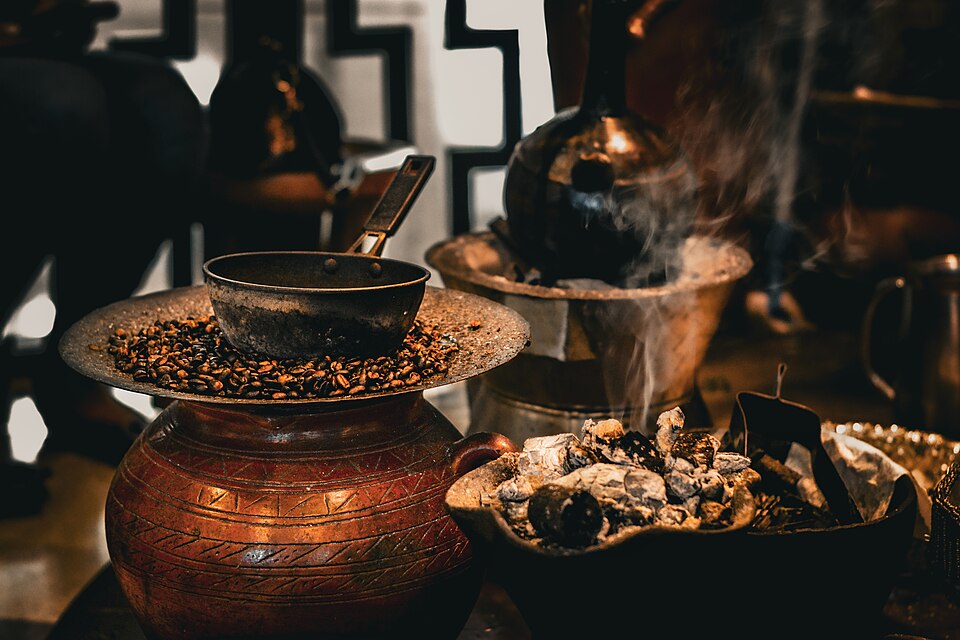
The host determines how long the coffee should boil. It may be brewed until it becomes very dark and strong or removed earlier for a lighter taste. The longer it boils, the darker, richer, and more intense the coffee becomes.
Serving the coffee is itself an art mastered over time. The strong, bitter coffee is commonly sweetened generously with sugar. A traditional Ethiopian buna may also be served with tena adam leaves. The host arranges a tray of small ceramic cups and pours the coffee in a smooth, continuous stream from the jebena, often from a considerable height above the cups—a skill far more difficult than it looks.

Clearly, a great deal of time, patience, and artistry goes into preparing one of the world’s most celebrated coffee traditions. And thank God for Ethiopia’s mastery of such a beautiful art.
Africa is a continent blessed with an extraordinary diversity of cultures, traditions, arts, foods, ceremonies, and forms of heritage passed down through generations. I respect the many beautiful cultures found outside Africa, but I will always have a special affection for the cultures and arts of the continent I call home. Forgive my bias.
So, I have made a promise to myself: whenever I travel to another African country outside my base, I will make time to experience and appreciate its cultures, foods, drinks, traditions, and, most importantly, its people.
You should do the same.
Welcome to Africa—the vast land of many cultures.
Coffee Benefits
Whether you drink it or not, you have likely been caught up by the tantalizing aroma of this rich, dark beverage.
Brain Power
Coffee, as you already know, contains a psychoactive substance known as caffeine. Caffeine works to block the functioning of adenosine, which causes dopamine and norepinephrine to increase. This increases energy and brain function and improves your response times; i.e., it gives you a boost. It is even said to help fight Alzheimer’s and Parkinson’s.
Metabolic Boost
Caffeine boosts your metabolic rate and has been known to increase fat burning in people.
Nourishment
Coffee has moderate amounts of Vitamin B3, B2, and B5 and also contains folate, phosphorus, magnesium, manganese, and potassium.
Helps Fight Type2 Diabetes
According to online sources, drinkers of coffee have a lower risk of getting Type2 Diabetes.
Diuretic
Coffee helps increase production of urine, which is a great way to keep flushing your body of toxins. This also increases toilet visits…
Antioxidant Rich
Coffee is loaded with antioxidants, which help fight free radicals in your body.
Liver Health
Coffee helps protect your liver against cirrhosis and cancer.
Skin Health
Used ground coffee beans can make for a great body scrub. The oils in the beans feed and nourish your skin and give it a great glow. But be mindful of blocking your drain!
Some of the benefits of drinking coffee can turn into harmful effects if consumed in excess or out of greed and mindlessness. It has even been known to have addictive effects.