

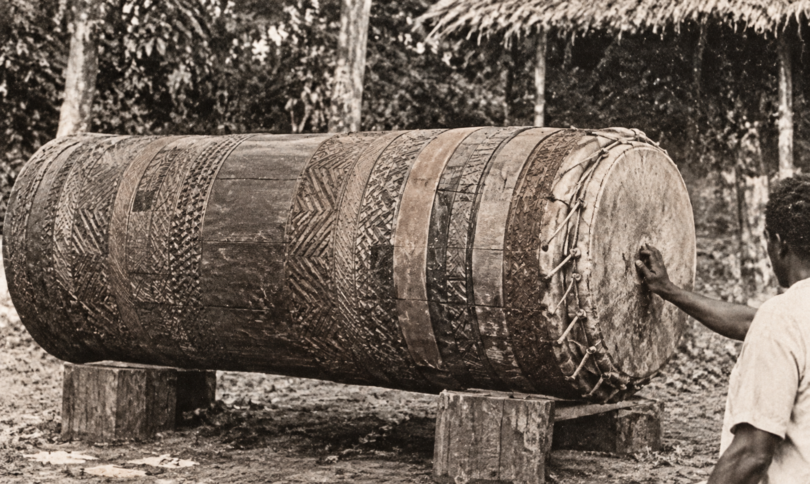

The return of Africa’s stolen cultural and artistic heritage has been the subject of much debate over the last century. Yet, despite numerous efforts to repatriate these ancient artefacts, an estimated 80% to 95% of Africa’s cultural heritage and historical artefacts remain outside the continent, held in Western and European museums.
Key Estimates and Breakdown
- General Estimates: Cultural experts, UNESCO forums, and landmark studies, such as the 2018 Sarr-Savoy Report commissioned by France, estimate that roughly 90% to 95% of all Sub-Saharan African cultural artefacts are held in foreign institutions.
- Specific Museum Holdings:
- The British Museum in London holds tens of thousands of African objects, including the Benin Bronzes, with some estimates putting the number at between 69,000 and 73,000 items.
- French public museums hold at least 90,000 Sub-Saharan African objects.
- The Restitution Debate: Many of these objects were acquired during the colonial era through military invasions, looting, murder, or unequal transactions. Although African nations and advocacy groups have increasingly demanded the return of these treasures, large-scale repatriation has been slow.
One such stolen African artefact is the Ngadji.
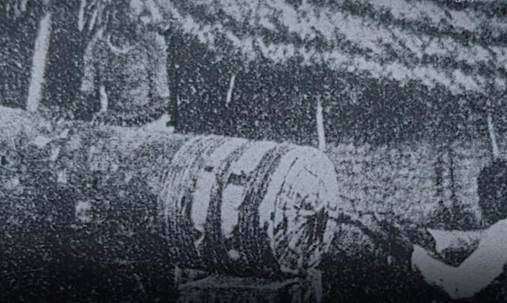
The only known photo of the Pokomo Ngadji drum. Source: Google.
The Ngadji, also known as the ngagi or gaji drum, is a sacred, giant friction drum belonging to the Pokomo people of Kenya’s Tana River Valley. Standing at over 9 feet tall (276.5 cm), it has spent more than a century locked away in the storage vaults of the British Museum in London. For the Pokomo, it represents the ultimate symbol of sovereignty, governance, and spiritual order.
Historical accounts indicate that British colonial officials seized the drum in 1902 during the Pokomo resistance to colonial land and tax policies in the Tana River region of present-day Kenya.
Cultural and Spiritual Significance
The Ngadji was not merely a musical instrument; it was the foundational centrepiece of the Pokomo way of life.
- The Sacred Tree: The drum was meticulously carved by master artisans from a single, hollowed-out trunk of the sacred mzinga tree and topped with cowhide. It was specifically designed to produce a massive, low-frequency reverberation that could be felt and heard for miles along the banks of the Tana River.
- The Kidjo Council: The drum belonged to the Kidjo, the governing council of elders and nobility who held custody of it on behalf of the community. It was kept hidden in secret forest groves, away from the eyes of the uninitiated and young children.
- Function: Its deep boom was used to rally communities, coordinate society, and signal the official enthronement of a new king.
The Colonial Theft (1902)
In 1902, British colonial officers, together with a Norwegian timber trader named Y. Anderson, seized the Ngadji at gunpoint while it was being transported down the Tana River in dugout canoes.
The British employed a “divide-and-rule” tactic. By stripping the Pokomo of the Ngadji, they shattered the community’s structural unity and significantly undermined the political and spiritual authority of the Kidjo council, making the population easier to subjugate and colonize. In 1908, the drum was officially gifted to the British Museum by colonial administrator Sir Alfred Claud Hollis.
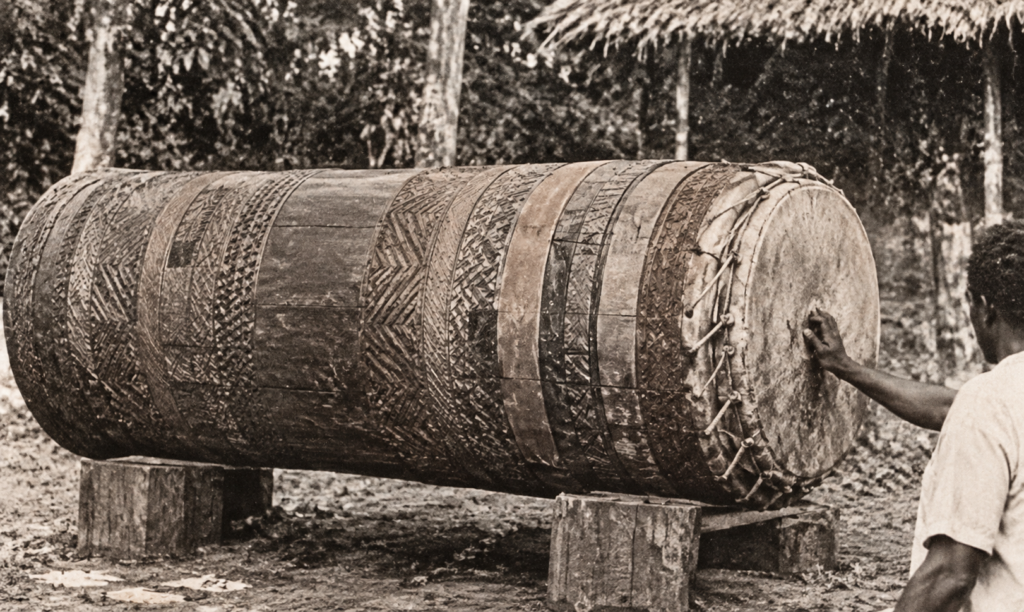
An artistic reconstruction of the Ngadji, the sacred drum of the Pokomo people of Kenya, based on the only known historical photograph. Created with ChatGPT.
The Fight for Restitution
The loss of the Ngadji has been lamented by generations of Pokomo elders, who trace the economic and social decline of their community back to its theft. Over the years, grassroots movements have intensified their efforts to bring the drum home.
- Rediscovery: In 2013, Mkidjo Baiba Mjidho, the brother of the Pokomo King, located the drum in a storage cupboard inside the British Museum’s Department of Africa, Oceania, and the Americas. He was the first Pokomo to see it in more than a century.
- The Refused Loan: In 2016, King Haye (Dr) Makorani-a-Mungase VII visited the museum to formally request the drum’s return. The British Museum refused full restitution, citing the British Museum Act of 1963, which legally restricts the deaccessioning of artefacts. Instead, it offered a “temporary loan”. The Pokomo Council of Elders categorically rejected the offer, insisting that they would not borrow what rightfully belonged to them.
- Current Campaigning: Working alongside platforms such as Open Restitution Africa and the Black Initiative Alliance, the Pokomo leadership continues to pressure the UK government for the drum’s unconditional return. They view the repatriation of the Ngadji not as an attempt to recreate the past, but as a necessary act of justice to restore their community’s historical identity, pride, and legal sovereignty.
In a documentary aired by DW Africa, King Haye (Dr) Makorani-a-Mungase VII offered a powerful perspective on the cultural and spiritual significance of the Ngadji and why its continued detention in the British Museum is deeply offensive to the Pokomo people.
Drawing a comparison with the Mace of Westminster, a symbol of authority in the British Parliament, he said:
“The Ngadji is like a Mace. Can you imagine if I had the Mace of Westminster, the Parliament in England, and I had it lying somewhere here, using it as a footstool? What would the British people think? It would be sacrilegious. To them, this is a drum for savages, but to us, it is a beautiful piece. Not only is it beautiful, but it also has uses; it has functions. Why should you deny an object its functions?”
The question remains: At what point will Europe and the West realize that it makes little sense for them to claim that their way of life is rooted in human rights and moral superiority, as they so often lecture Africans, when many of the objects in their museums—and even elements of their own history—are stolen goods and gains of bloodshed? These are treasures acquired through the shedding of innocent blood, the destruction of thriving communities, and the systematic dispossession of Africans and other Indigenous peoples across the world.
How can nations that continue to hold on to the spoils of colonial violence presume to occupy the moral high ground while lecturing others on human rights, justice, and civilization?
