


With Nigeria facing rising substandard, fake medications, and drug resistance, ethnopharmacology offers robust alternatives for managing intestinal helminths.
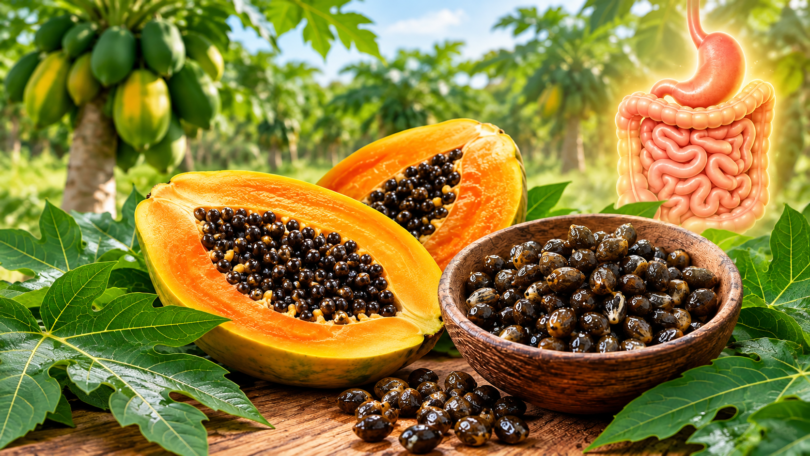
One of the most effective, clinically studied botanical interventions centers on pawpaw seeds (Carica papaya).
Far from a basic home remedy, this protocol relies on active, volatile plant chemistry to disrupt parasite lifecycles.
Pawpaw is more than a fruit. The seeds contain biologically active compounds that have demonstrated anthelmintic activity, and human research has investigated their use against intestinal parasites.
In a Nigerian pilot study, an air-dried pawpaw-seed preparation combined with honey produced parasite clearance in 76.7% of treated children after seven days, compared with 16.7% in the honey-only group.
But here is the important part: how you prepare the seeds matters.
WHAT YOU NEED
You need only:
* Fresh ripe pawpaw
* The seeds
* Raw honey, if desired
* A clean bowl
* A clean spoon
* A blender or mortar and pestle
Do not use pawpaw pulp as the active ingredient. The protocol is specifically about the seeds.
STEP 1: COLLECT THE SEEDS
Cut open a ripe pawpaw and remove the seeds.
Wash away the surrounding fruit pulp thoroughly.
Place the seeds on a clean tray.
You have two options:
OPTION A — FRESH SEEDS
The seeds can be used fresh after cleaning.
OPTION B — AIR-DRIED SEEDS
Spread the cleaned seeds in a clean, dry place and allow them to dry completely.
The advantage of drying is that the seeds can subsequently be crushed into a more consistent preparation.
Do not roast or fry the seeds.
The objective is to avoid unnecessary heat exposure that may alter heat-sensitive enzymes and other plant constituents.
STEP 2: GRIND THE SEEDS
Once completely dry, place the seeds in a clean mortar and pestle or blender.
Grind them into a coarse-to-fine powder.
You do not need to turn them into an ultra-fine flour.
Store only a small quantity in a clean, dry, airtight container.
For maximum freshness, prepare small batches rather than keeping ground seeds for long periods.
STEP 3: HOW TO TAKE IT
Pawpaw seeds have a naturally strong, peppery and bitter taste.
A practical way to take them is to mix the measured seed preparation with a small amount of honey.
The honey is primarily useful for palatability and formulation.
If you can handle the natural taste without adding honey, there is absolutely no problem.
In the Nigerian clinical study, researchers specifically used an air-dried pawpaw-seed preparation formulated with honey. The study administered a 20-mL preparation to children, but the paper does not establish that 20 mL is an appropriate adult dose.
Therefore, do not simply convert the children’s study into an adult prescription.
If you are an adult considering pawpaw seeds therapeutically, use a measured preparation rather than eating handfuls of seeds.
This is important because “natural” does not mean “dose doesn’t matter.”
HOW MUCH IS ENOUGH?
This is where many internet protocols become misleading. That’s why sometimes you need an oversight and guide without relying on internet material.
There is no well-established, universally accepted adult dose of whole pawpaw seeds for deworming.
Human studies have used different preparations and doses.
One Nigerian study reported an effect using approximately 4 g of papaya seeds daily in children, while another school-based study used 10 g of ground seeds daily in fortified porridge for two months. The researchers themselves noted that the optimal dose and frequency still needed to be established.
Therefore:
Do not assume that 10 g, 20 g, 30 g or a handful of seeds is automatically a better deworming dose.
More is not necessarily more effective.
For a reproducible clinical protocol, the preparation would need standardized seed weight, phytochemical content, parasite diagnosis and monitoring.
WHEN SHOULD YOU TAKE IT?
Traditionally, pawpaw-seed preparations are often taken in the morning, sometimes before food.
If you choose this approach, taking the preparation before breakfast may make the routine easier to follow.
However, there is no strong human evidence showing that an empty stomach makes pawpaw seeds clinically superior to taking them with food.
If taking the seeds causes significant nausea, stomach pain or diarrhea, stop rather than forcing the protocol.
WHAT IS HAPPENING PHARMACOLOGICALLY?
The purpose of using pawpaw seeds is not simply to “flush worms out.”
The seeds contain several bioactive constituents.
- Benzyl isothiocyanate
Pawpaw seeds contain benzyl isothiocyanate and related compounds that have demonstrated biological activity.
These compounds are among the reasons researchers have investigated pawpaw seeds as potential antiparasitic agents.
- Cysteine proteases
Papaya contains proteolytic enzymes.
Experimental research has demonstrated anthelmintic activity from papaya cysteine proteases against parasitic worms. However, much of the mechanistic evidence comes from experimental models rather than definitive human trials. (PubMed)
- Seed oils and other phytochemicals
The seeds also contain fixed oils and other phytochemicals that may contribute to biological activity.
Laboratory research has found the seed extracts to possess anthelmintic effects, but laboratory potency should not be confused with a proven human therapeutic dose. (PubMed)
DO YOU NEED TO “PURGE” THE WORMS?
Not necessarily.
One of the common misconceptions surrounding herbal deworming is that you must experience dramatic diarrhea or see worms in your stool for the treatment to have worked.
You do not need violent purging.
The intestine has its own motility system. If parasites are affected, intestinal contents can be eliminated through normal bowel movements.
Do not deliberately combine pawpaw seeds with strong laxatives, purgatives or multiple bitter herbs simply to force a bowel movement.
That can produce dehydration, electrolyte disturbances and unnecessary gastrointestinal irritation.
WHAT SHOULD YOU EAT DURING THE PROTOCOL?
Keep food simple.
Prioritize:
* vegetables
* fruits
* legumes according to tolerance
* whole grains or tubers
* adequate protein
* adequate water
* nutrient-dense traditional foods
There is no good evidence that you need to starve yourself, fast for several days or eliminate all carbohydrates to make pawpaw seeds work.
The goal is parasite management, not gastrointestinal punishment.
AFTER THE PROTOCOL: REBUILD THE GUT
Deworming should not become an excuse to neglect nutrition.
Afterward, focus on rebuilding a healthy dietary environment.
PREBIOTICS
Feed beneficial intestinal microorganisms with fiber-rich foods such as:
* onions
* garlic
* leeks
* vegetables
* legumes
* fruits
* other fiber-rich plant foods
FERMENTED FOODS
Appropriately prepared fermented foods can be incorporated into the diet where tolerated.
PROTEIN AND MICRONUTRIENTS
Ensure adequate protein, iron, zinc, folate and other essential nutrients.
This is particularly important in people who have had recurrent parasitic infections or nutritional deficiencies.
