

This antique photograph was captured around 1916 by British anthropologist Thomas Narcote in Umuahia, Nigeria.
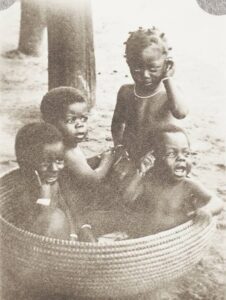
1916 by British anthropologist Thomas Narcote in Umuahia, Nigeria.
Earlier today, Maazi Ogbonnaya Okoro II shared a photograph of Igbo children in Ụmụahịa taken around 1916, one hundred and ten years ago. His words stayed with me:
“See how healthy they looked. They ate good food and sucked well-fed ara nne ha… We are what we eat. And food influences the way we think, including our health and complete well-being.”
Before anyone misunderstands where I am going with this, let me make something clear.
Those children were not living in paradise. Infant mortality in 1916 existed, but not as the data actually captured it. According to existing literature, there were no antibiotics, no vaccines, no clean water systems, and many children never reached adulthood. Anyone who romanticizes that era is ignoring history. But could this actually be true?
I do not agree! In fact, we had so much from our biodiversity and availability. Sometimes we speak as though our traditional doctors didn’t do much, and that’s terrible. We had systems to respond to almost every situation, but the swift introduction of the Western approach played down and never allowed for the advancement of the intergenerational knowledge passed down to us.
Again, there is one truth we cannot ignore.
Those children then grew up inside a food environment.
But today, our children are growing up inside a marketing environment.
That is the entire argument.
Everything else is evidence.
In November 2025, the Swiss watchdog Public Eye released its second investigation into Nestlé’s baby foods. Working alongside civil society organizations across twenty African countries, nearly one hundred Cerelac products were collected and analyzed by Inovalys, one of France’s leading agri-food laboratories.
The results were difficult to ignore.
More than 90% of Cerelac products sold across Africa contained added sugar. The average serving contained almost six grams of added sugar, about one and a half sugar cubes. The highest level recorded was 7.5 grams in a product marketed for six-month-old babies in Kenya. Cerelac containing seven grams or more per serving was identified in seven African countries. Even more concerning, roughly two-thirds of these products did not separately disclose the added sugar content on their nutrition labels.
Now compare that with what happens elsewhere.
In Switzerland, where Nestlé is headquartered, its flagship baby cereal contains no added sugar.
In Germany and the United Kingdom, every Cerelac product intended for babies from six months of age also contains no added sugar.
After the 2024 scandal in India affected Nestlé’s market value, the company introduced fourteen new no-added-sugar Cerelac variants within a single year.
Meanwhile, the average added sugar level found in African Cerelac products is about 50% higher than what Public Eye documented across Asia and Latin America in 2024, and roughly double what is now sold in India.
Nigeria deserves special attention because it is Nestlé’s largest Cerelac market in Africa, worth more than USD 50 million annually. Across the continent, Cerelac sales exceed USD 250 million, with Nestlé controlling more than half of that market.
Twenty civil society organizations from Benin, Burundi, Cameroon, Côte d’Ivoire, Morocco, Mozambique, Namibia, Nigeria, Senegal, South Africa, Togo, Tunisia and Zimbabwe wrote to Nestlé’s CEO in November 2025.
Their message contained only six words.
“All babies are equal.”
Nestlé responded by insisting that the findings were misleading, that the sugars originated from milk, cereals and fruit, and that the company does not mislead consumers.
The laboratory reached a different conclusion.
That is precisely why we conduct laboratory analyses instead of debating opinions.
Chineke Nna!
What troubles me most is not even the sugar itself. It is when the sugar is introduced.
Every human baby enters the world with an instinctive preference for sweetness. Evolution designed that preference for survival. For almost all of human history, sweetness signaled one of only two things: breast milk or ripe fruit. Both were safe. Both were seasonal. Both arrived packaged with fiber, water, enzymes and micronutrients.
Refined sugar is something entirely different.
Evolutionary biologists describe it as a supernormal stimulus, an exaggerated version of a natural signal that overwhelms biological systems originally calibrated for something much milder. A brain designed to recognize the sweetness of pawpaw suddenly encounters the intensity of refined sugar.
The timing makes it even more significant.
Food preferences are not fixed at birth. They are programmed.
The first two years of life represent one of the most important developmental windows for shaping lifelong taste preferences. Coincidentally, or perhaps not, that is exactly when complementary foods like Cerelac are introduced.
The World Health Organization has consistently warned that exposing infants to added sugars during this period encourages a lifelong preference for sweeter foods. That is why WHO guidance recommends no added sugar in foods intended for children under three years of age.
So when sugar is added to cereal designed for a six-month-old baby, this is no longer about a few extra calories.
It is programming.
It is teaching a developing nervous system what food should taste like.
It is establishing a biological baseline that may influence dietary choices for decades.
That is no longer nutrition; that is customer acquisition beginning at six months of age.
The irony is that Nestlé already understands this. On its own South African parenting website, the company explains that children become accustomed to sweet foods, acknowledges both the short- and long-term risks associated with high sugar intake, and recommends limiting added sugars.
They know. They wrote it themselves.
Yet the products sold across much of Africa continue to tell a different story.
And this story becomes even more troubling when viewed through the lens of African biology.
Sugar does not enter identical bodies.
It interacts with genomes shaped by different evolutionary histories.
A child whose mother experienced undernutrition during pregnancy may develop what researchers describe as a thrifty phenotype, a metabolism programmed to expect scarcity. Appetite regulation, insulin sensitivity, fat storage and pancreatic development are all adjusted for survival in a resource-limited environment.
When that same child is then introduced to refined sugar during weaning, biology encounters an enormous mismatch.
Africa is now living through that mismatch.
Most countries on the continent carry what public health experts call the double burden of malnutrition—stunting and obesity existing side by side, sometimes within the same household and occasionally within the same child.
The number of overweight African children under five has almost doubled since 1990.
If current trends continue, obesity across Africa could increase by more than 250% by 2050, with approximately one in every two adults living with overweight or obesity.
That is not Europe’s risk profile.
It is ours.
The RODAM Study made this even clearer. Following Ghanaians living in rural Ghana, urban Ghana and Europe, researchers observed dramatically different rates of obesity, hypertension and type 2 diabetes despite shared ancestry.
The genes did not suddenly change.
The food environment did.
And there is another layer that deserves attention.
Certain populations of West African ancestry carry genetic variants, including APOL1 risk alleles, that increase vulnerability to kidney disease. These variants often remain relatively harmless until they encounter metabolic stress from hypertension, insulin resistance, or diabetes.
Sugar does not create those genetic risks.
It amplifies them.
Even our relationship with milk differs.
Most West African populations are lactase non-persistent, unlike many European populations where adult lactose digestion became common through pastoralist evolution. Yet modern growing-up milk products assume a dairy-centred childhood that many African children were never biologically adapted to.
Our children are not miniature Europeans.
Designing infant foods around European physiology and then adding extra sugar under the assumption that “African palates prefer sweetness” is not cultural sensitivity.
It is market segmentation.
The downstream consequences are well documented.
Excess sugar contributes to mitochondrial dysfunction, insulin resistance, chronic inflammation, microbiome disruption, and emerging evidence also links excessive early-life sugar exposure with neuroinflammation affecting learning and memory in experimental models.
Where the science remains uncertain, such as accelerated ageing and telomere shortening, we should say so openly.
We do not need exaggeration.
The evidence is already compelling enough!
Our children’s cells are keeping a record of what we feed them. That record is being written right now, during the first thousand days of life, and it does not simply disappear.
Dear parent, read the label. If it is too sweet for you, it is far too sweet for your child.
And to the rest of us, this is not a boycott post.
It is a receipt.