

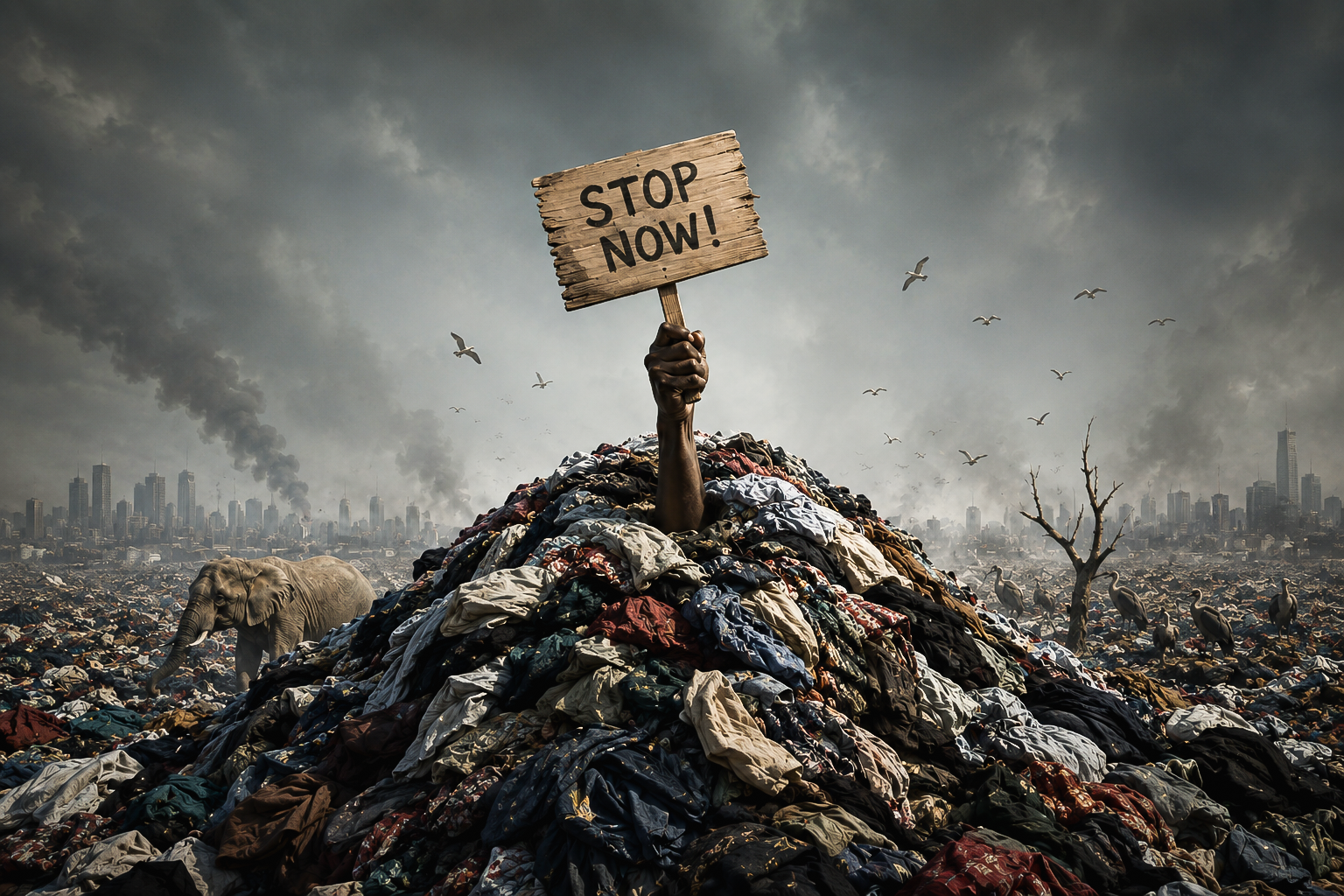

As British journalist Lucy Siegle said:
“Fast fashion isn’t free. Someone, somewhere is paying.”
The Conversation That Changed Everything
It began as an ordinary conversation with a friend who earns her living selling imported second-hand clothes, known in Kenya as mitumba. Like many traders across Africa, she buys retail from traders who get tightly packed bales from wholesalers who import them from Europe, North America, and Asia. Every bale is a mystery. Until it is opened, nobody knows whether it contains fashionable garments that will sell quickly or damaged clothing destined for the rubbish heap.
As we talked, she mentioned something that caught me completely off guard.
Some of her best-selling items were women’s underwear.
Used bras, used panties. Garments that had once belonged to strangers living thousands of kilometers away.
Curious, I asked why people bought them.
“They’re better,” she explained. “They’re from famous brands. They last longer than the cheap new ones.”
Then I asked her a simple question.
“If your closest friend brought you the underwear she had already worn, would you wear it?”
She laughed immediately, but with an obvious worry in her eyes, she said.
“Of course not.”
“So why,” I asked, “does it become acceptable simply because the previous owner lives in another country?”
The smile disappeared. She had never thought about it.
Yet that brief conversation opened the door to a much bigger question—one that reaches far beyond clothing. It is a story about consumerism, fast fashion, environmental justice, African industry, and the future of our continent.
The Global Machine Called Fast Fashion
Over the past four decades, clothing has become cheaper than at any other time in history.
Fashion companies now produce enormous quantities of garments at remarkably low prices, encouraging consumers to buy more and replace their wardrobes every season. This phenomenon, known as fast fashion, has transformed shopping into an endless cycle of buying, wearing briefly, and discarding.
The consequences are staggering.
According to the material on which this article is based, approximately 1.7 billion pounds of used clothing enter Africa every year, while the global second-hand clothing trade has grown into a business worth billions of dollars. Kenya alone imported around US$200 million worth of used clothing in 2023, and Ghana reportedly receives 15 million garments every single week. Even more concerning, up to 40 percent of those clothes cannot be resold, eventually becoming waste.
This raises an uncomfortable question.
If almost half of these imported clothes are effectively rubbish, who bears the cost of disposing of them?
The answer is increasingly clear. Africa does.
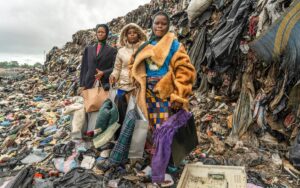
Source: pinterest.com
When Donations Become a Burden
Many of the clothes shipped to Africa began their journey as donations.
People cleaned out wardrobes believing their unwanted clothes would help someone in need. While many donations are genuinely useful, the sheer volume generated by fast fashion has overwhelmed the system.
Across Africa, traders buy sealed bales without knowing what lies inside. Some recover their investment. Others lose money because much of the clothing is torn, stained, moldy, or simply unsellable. It is a gamble disguised as commerce.
What cannot be sold eventually finds its way into overflowing landfills, rivers, drainage channels, beaches, and open-air dumps.
In Ghana, investigations have documented beaches buried beneath layers of discarded textiles, while landfills continue to expand under mountains of synthetic clothing that may take decades—or even centuries—to break down.
What began as “charity” often ends as someone else’s environmental crisis.
The Hidden Pollution in Our Wardrobes
Few people think about what happens before used clothing reaches African markets.
To survive long journeys by sea, many garments are compressed into dense bales and treated with industrial preservatives and disinfectants designed to prevent mold, insects, and deterioration during transport.
The source material raises concerns about residues from disinfectants, preservatives such as formaldehyde-based compounds, and pesticides used during shipping and storage.
Eventually, these garments must be washed.
Multiply that process by billions of pounds of clothing every year, and another important environmental question emerges.
Where does all that chemically contaminated water go?
Into rivers. Into lakes. Into streams. Into farmland. Into the ecosystems that sustain African communities. And finally, into our food, drinking water, and into our lives.
Whether discussing textile fibers, chemical residues, or the growing problem of microplastics, the environmental footprint of fast fashion extends far beyond the clothes themselves.
The Industry Africa Lost
The tragedy is not only environmental, but it is also economic.
Across the continent, textile industries that once employed thousands have struggled to compete with the constant flow of inexpensive imported clothing.
Every imported shirt represents cotton that local farmers did not grow. Every imported dress represents work that local tailors did not receive. Every imported bale represents factories that never reopened and young designers who struggle to compete against products sold for a fraction of their true cost.
Africa possesses extraordinary creativity, constantly dulled down by imports.
From Lagos to Nairobi, Accra to Johannesburg, African designers are producing fashion admired around the world. What they often lack is not talent, but the supportive policies and consumer demand needed to scale local manufacturing.
Choosing African-made clothing is not merely a patriotic gesture; it is an investment in jobs, creativity, entrepreneurship, and long-term economic resilience.
Rwanda Chose a Different Direction
Not every country has accepted the status quo.
Rwanda took the controversial decision to increase tariffs on imported second-hand clothing as part of its strategy to revive domestic textile manufacturing. Although the policy resulted in the loss of certain trade benefits, Rwanda maintained its position, arguing that rebuilding local industry was worth the cost.
Whether one agrees with that policy is beside the point; the larger lesson is that African nations still have choices. The future of the continent’s textile industry is not predetermined. It is entirely up to us to create it.
The Price of Living Fast
Fast fashion reflects a wider culture of speed.
We want fast food.
Fast delivery.
Fast technology.
Fast profits.
Now we have fast clothing.
The problem is that nature does not operate at the same pace as consumer culture.
The Earth absorbs every discarded garment, every polluted stream, every landfill, and every cloud of smoke rising from burning textile waste.
Someone always pays the environmental bill.
Too often, that someone is Africa.
Choosing a Different Future
The solution is not as simple as banning second-hand clothing overnight. Millions of Africans depend on this trade for their livelihoods, and any transition must protect those whose families rely on it. But we cannot ignore the larger reality.
Africa deserves more than becoming the final destination for the world’s excess consumption.
Governments can create policies that encourage local textile manufacturing; businesses can invest in African-made fabrics and clothing; consumers can support local designers whenever possible.
Communities can recycle, repair, and buy more intentionally instead of embracing a culture of endless consumption.
Real change rarely begins with governments alone.
It begins with ordinary people asking difficult questions and making different choices.
A Wardrobe That Reflects Our Values
Our wardrobes tell stories. They reveal what we value. They reveal what kind of economy we support. And increasingly, they reveal what kind of planet we are leaving behind.
Africa is not the world’s rubbish bin. Africa is the Motherland of Humanity, and no one puts waste on their mothers.
Africa is home to some of humanity’s oldest civilizations, remarkable creativity, abundant natural resources, and one of the youngest populations on Earth. As the continent looks toward the future, it has an opportunity to build an economy rooted not in imported waste, but in innovation, sustainability, craftsmanship, and dignity.
What should we do going forward:
- Buy less and only when you truly need it.
- Focus on quality over quantity.
- Reuse, mend, or even upcycle what you already have.
- Buy from sustainable local brands.
- Prefer organic and low-water fabrics, such as linen, hemp, and organic cotton.
- Wash your clothes less and according to the label to make them last longer.
- Wash new clothes before using them for the first time to get rid of some of the toxins.
The next time we stand before a clothing rack, perhaps the most important question is not “How much does it cost?”
Perhaps the better question is:
“What kind of future am I helping to create by buying it?”
