

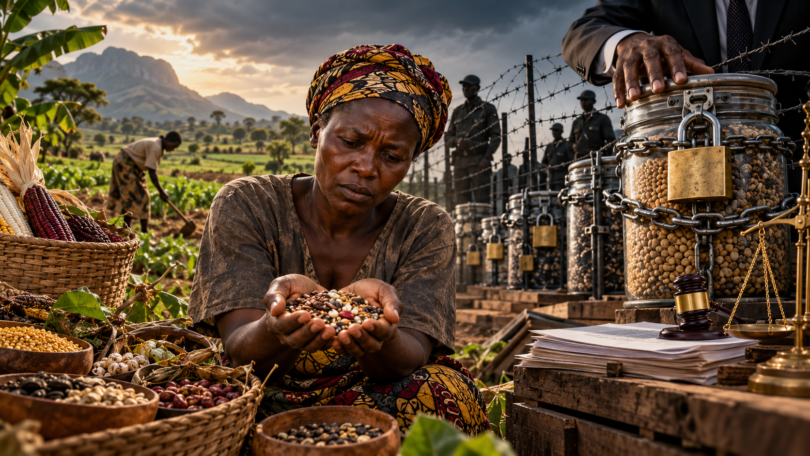

If you walk into any grocery store in the world today, you are presented with an illusion of infinite choice.
Beautiful-looking and almost too perfect varieties of fruits and food crops displayed under bright fluorescent lights, perfectly waxed, perfectly uniform, perfectly round. What they won’t tell you is that, a little over 100 years ago, North America alone was home to over 17,000 distinct apple varieties. 17,000 unique genetic signatures. Each bred across generations to survive specific droughts, resist specific frosts, and thrive in specific soils without a single drop of chemical spray.
Today, more than 86% of those native apple varieties have completely vanished from the face of the earth. 17,000 unique genetic signatures, each bred across generations to survive specific droughts. Today, more than 86% have vanished. Why? To find the answer, we have to look back at the enclosure of the seed.
To get a clearer perspective on the massive loss of plant varieties that has hit the world in the last 100 years, we queried online to find out how many varieties of rice have been lost globally in the last 100 years. The answer was shocking; it says:
Globally, exact figures for the total number of distinct rice varieties lost across the entire planet over the last 100 years are not fully recorded, but regional data show a massive collapse of agricultural biodiversity—with individual countries like India losing over 90% to 95% of their traditional landraces.
Key Scale of Loss
- India’s Decline: India transitioned from having roughly 100,000 to 110,000 indigenous rice varieties prior to the 1970s down to only about 6,000 remaining active traditional varieties today. This represents a loss of over 93% to 95% of its native rice heritage in just a few decades.
- The Green Revolution: The sharpest acceleration of this loss occurred post-1960s and 1970, when high-yielding, uniform hybrid monocultures displaced thousands of locally adapted heirloom landraces.
- Local Extinctions: Micro-regions have documented catastrophic local drops; for example, pockets in Bangladesh and West Bengal have lost dozens of specialized flood-tolerant, drought-resistant, or medicinal rice types (such as iron-rich or silver-absorbing strains) in very short windows.
The case of Indian rice varieties is just one among the many regional losses of plant varieties across the globe.
What happened to global plant varieties?
In the hills of the Pacific Northwest, a retired FBI agent named David Benco spends his days searching for dead men’s trees. Armed with century-old county maps, tax ledgers from the 1890s, and faded yellow land deeds, he hikes into forgotten canyons where 19th-century homesteaders once lived. He isn’t looking for gold or silver. He is hunting for extinct apples. The Dickinson, the Nero, the Arkansas Beauty, the Stre Pippin.
Varieties that mainstream agricultural history officially declared extinct decades ago. Trees planted by pioneers before the turn of the 20th century, surviving quietly in the wild without human intervention for over 80 years.
Why did these resilient, self-sustaining crops disappear from our tables in the first place? To understand how thousands of natural food varieties were erased in less than three generations, we have to look past the orchard walls and examine the boardrooms of 1930.
Since the dawn of agriculture 10 millennia ago, humanity has operated under an unspoken universal principle. The seed was a commons – it belonged to no single person, no kingdom, and no empire. When a farmer discovered a weak plant that stood strong against a dry summer, he saved its grain. When a gardener cultivated a squash that stored through a long winter, she shared its seeds with her neighbors. This decentralized open-source network of seed saving created an explosion of biodiversity.
Every valley, every mountain slope, every soil type had its own localized food varieties. Hunger occurred during natural cataclysms, but the global food system itself was infinitely decentralized.
No single entity held the key to the harvest.
Then came the 1920s. Industrialization was reshaping the world’s skylines, centralizing energy into metered grids, and enclosing public lands into private assets. But one vital sector of the global economy remained stubborn, decentralized, and impossibly difficult to control: the seed. On May 23rd, 1930, President Herbert Hoover signed a document that passed through Congress with surprisingly little public debate.
It was called the Plant Patent Act of 1930.
On the surface, it was pitched as a benevolent measure to reward plant breeders like the famed Luther Burbank for their creative labor in developing new ornamental flowers and fruit trees. For the first time in human history, the law recognized a living organism as a patentable private technological invention.
Under public law 71-245, a company or individual who created an asexual plant mutation could claim legal ownership over its genetic structure. It sounded harmless, but it introduced a radical, dangerous precedent into Western jurisprudence.
The concept that nature itself could be owned, licensed, and restricted by corporate contract.
Once living plants could be patented, the economic incentives of global agriculture underwent a violent mutation.
Commercial nurseries and seed houses no longer profited from selling open-pollinated native seeds that farmers could reproduce for free. They needed proprietary varieties, crops that required specialized fertilizers, crops that could not be easily reproduced, crops that carried legal protection against unauthorized propagation.
Within 50 years of the 1930 Act, thousands of open-pollinated, self-sufficient heirloom crops were quietly dropped from commercial catalogs. If a crop couldn’t be patented, it wasn’t advertised. If it wasn’t advertised, nurseries stopped growing its rootstock. And when the last generation of farmers who held those seeds passed away, the living genetic memory was lost forever.
The hybrid trap and terminator seeds
By the mid-20th century, the enclosure of agriculture accelerated with the introduction of F1 hybrid technology.
Hybrids were created by crossbreeding two highly inbred parent lines. The first generation, the F1 crop, produced extraordinary uniform yields. But there was a catch. A catch that corporate seed executives realized was worth billions of dollars.
If a farmer tried to save seeds from an F1 hybrid harvest and plant them the following spring, the resulting F2 generation decomposed into a chaotic mix of low-yielding, genetically unstable traits. For the first time in 10,000 years, the seed’s natural ability to reproduce itself was biologically broken. The biological barrier achieved what legal patents alone could not. It forced the farmer to come back to the seed company every single spring. The annual seed subscription was born. By the 1990s, three chemical cartels had acquired hundreds of independent regional seed companies, consolidating over 50% of the global commercial seed market under a handful of corporate roofs.
Then came genetically modified seeds engineered to survive heavy applications of proprietary herbicides and, with them, the technology use agreement. Farmers who bought these seeds were forced to sign legal contracts granting corporate investigators the right to enter their private lands, inspect their storage bins, and take DNA samples of their crops. If patented GMO pollen blew on the wind from a neighboring farm into an organic farmer’s field, corporate lawyers filed multi-million-dollar lawsuits against the organic farmer for patent infringement.
The ancient act of saving seeds was no longer just obsolete. It was legally treated as theft.
The doomsday vault and the fragile grid
1,300 km beyond the Arctic Circle, carved 120 m deep into the sandstone perafrost of Spitsbergen Island sits a structure designed to outlast civilization.
The Svalbard Global Seed Vault, known to the public as the Doomsday Vault.
Inside these frozen rooms held at minus 18 °C are over 1 million unique samples of crop seeds gathered from almost every nation on Earth. The official story is inspiring. A subterranean insurance policy for humanity, preserving crop diversity against climate change, nuclear war, and global disaster. But look beneath the noble public relations campaign, and an unsettling paradox emerges.
Why did we build a multi-million-dollar frozen fortress in the Arctic permafrost to preserve seeds in state-backed stasis while simultaneously allowing the living, dynamic food forests and heirloom fields of our planet to be cleared, patented, and replaced with sterile monocultures? A seed stored in a frozen vault is a captive seed. It is frozen in time, unable to adapt to changing soils, evolving pests, or shifting climates.
True resilience doesn’t live in a vault beneath the permafrost. True resilience lives in the hands of millions of independent farmers planting, saving, and adapting open-pollinated seeds in living soil every single year.
Reclaiming the commons
Yet, despite a century of legal patents, chemical monopolies, and corporate consolidation, the 10,000-year-old cycle has not been broken completely. Across the world, a quiet decentralized resistance is taking root.
From seed savers in the Appalachian Mountains, preserving 200-year-old corn varieties, to indigenous seed sanctuaries in South America, resilient indigenous seed growers in Africa taking their governments to court over punitive seed laws, and open-source seed initiatives in Europe, thousands of people are keeping the living libraries alive. They understand a truth that no patent law can erase. That true security is not found in corporate subscriptions but in community self-sufficiency.
The history of the last 100 years was defined by enclosure, the transformation of the atmospheric grid into metered power, the clearing of free food forests into taxable plantations, and the patenting of the seed into a corporate asset. But every time you plant an open-pollinated heirloom seed in your garden, save its yield, and hand an envelope of those seeds to your neighbor, you are performing an act of quiet restoration. You are stepping out of the subscription and reconnecting with a 10,000-year-old heritage of human freedom.
The vault in Svalbard holds the past, but the future still waits in the soil beneath our feet, and it’s our collective duty and responsibility to prepare the enabling environment for new life to rise.
