


A rumour has circulated that Burkina Faso is setting up a new justice system that lets inmates serve their communities through farming, thereby reducing their prison sentences. According to the story, for every month they spend working on farms to produce food for their communities, three months are deducted from their sentences.
I am not sure how true this is, but it seems to be a popular story on YouTube and other social media platforms. Interestingly, however, you hardly see anything about it on mainstream news platforms.
Am I surprised that this is the case? Absolutely not.
For the most part, it is only the negative things happening in Africa that attract the attention of the mainstream media. In fact, how dare an African country establish a different justice system outside what the West and Europe approve of as legitimate?
Nonetheless, I think we have moved past such stupidity, and more Africans are beginning to realize that Europe and the West are not the standard by which everyone else in the world must live. And I care less about what anyone thinks of this.
In trying to establish the truth about this new justice system that Burkina Faso has reportedly enacted, I conducted a basic search using the Brave AI browser.
My query was: Is it true that Burkina Faso allows inmates to serve one month on the farm to reduce their sentences by three months?
Here is the answer it gave me:
Yes, it is true. Under Burkina Faso’s prison reform and the Travaux d’Intérêt Général (TIG) framework enacted under President Ibrahim Traoré, inmates and individuals in pre-trial detention who work in the agricultural sector receive a three-month reduction in their sentences for every one month of agricultural labor they complete.
Key details of the programme include:
- The Exchange Rate: One month of work at state agricultural facilities, such as the Baporo Agricultural Penitentiary Centre, equates to a three-month reduction in a prisoner’s sentence.
- Who Is Covered: The policy applies to both convicted prisoners and certain individuals held in pre-trial detention.
- Goals: The initiative is designed to combat prison overcrowding, teach practical farming and trade skills, promote rehabilitation, and boost national food security by cultivating crops such as maize, rice, sorghum, soybeans, cowpeas, and sesame.
- Background: The approach revives open-environment agricultural detention models historically used in Burkina Faso, such as the one at Baporo, which was first established in 1986.
While I believe more research needs to be done to establish how effective this programme has been since its introduction, the very thought of such an initiative warms the heart, especially when viewed from the perspective of restorative justice.
I mean, what is the point of locking up able-bodied men and women in overcrowded prisons, where they have to be fed and clothed using their country’s limited resources, when they could instead be contributing to the production of food and other much-needed resources for their country during their sentences? At the very least, if nothing else, it helps remind inmates that they are still worthy of opportunities to contribute to their country, even while incarcerated. I see this as a form of restorative justice, even though it might sound too simplistic.
I am very much aware that restorative justice, as a term, has its own established definition, which can be quite complex to explain in a single article. However, I want to approach it from the perspective of how restorative justice reintroduces people to their true identity and personhood, which I believe are deeper and more foundational than whatever crime they may have committed that led to their incarceration.
I am of the opinion that every human being possesses the ability to do both good and bad, and that beyond these two realities lies the true identity of a person. This identity must be given a voice beyond the good or bad things a person has done. Let me explain further with a story from the Himba tribe of Namibia.
The Power of Identity and Community
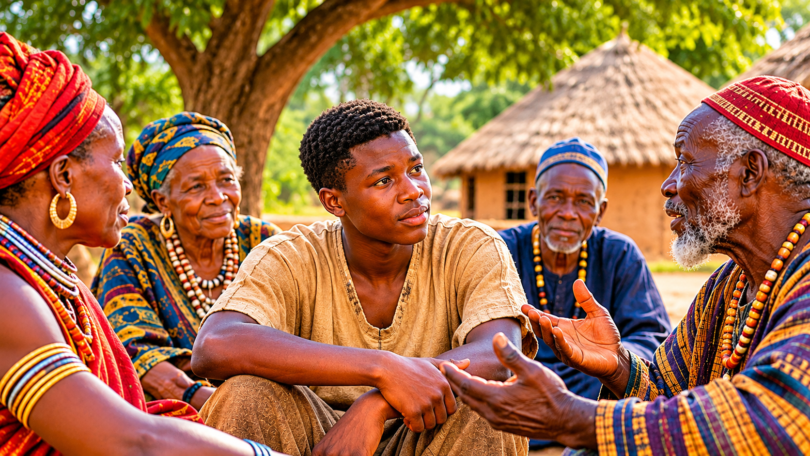
In the Himba tribe of Namibia, in southern Africa, the date of birth of a child is fixed, not at the time of their arrival in the world, nor at the time of their conception, but much earlier: from the day the child is first thought of in their mother’s mind.
When a woman decides that she is going to have a child, she settles down and rests under a tree, listening until she can hear the song of the child who wants to be born. After hearing this child’s song, she returns to the man who will be the child’s father and teaches him the song. Then, when they make love to conceive the child physically, they sing the child’s song to invite him or her.
When the mother becomes pregnant, she teaches the child’s song to the midwives and older women of the village. So, when the child is born, the older women and the people around them sing the child’s song to welcome them into the world.
As the child grows, the other villagers learn their song. So, if the child falls or gets hurt, they will always find someone to pick them up and sing their song. Similarly, if the child does something wonderful or successfully passes through the rites of passage, the people of the village sing their song to honour them.
In the tribe, there is another occasion when the villagers sing for the child. If, at any time during their life, the person commits an aberrant crime or antisocial act, they are called to the centre of the village, and the people of the community form a circle around them. Then they sing their song.
The tribe recognises that the correction of antisocial behaviour does not come through punishment, but rather through love and a reminder of identity. When you recognise your own song, you do not want or need to do anything that would harm another person.
And the same continues throughout their lives. In marriage, songs are sung together.
And when, having grown old, this child is lying in their bed, ready to die, all the villagers know their song, and they sing it for the last time.
While this story can be interpreted as metaphorical, metaphysical, or even real, it nevertheless draws our attention to what restorative justice could look like, without all the drama that our modern-day justice systems have come to associate with justice.
I, for one, believe that justice that does not create healing, restoration, and balance is not justice at all, but rather an application of the law that ends up breaking the very law it is supposed to uphold.
Am I saying there should be no laws or justice in our world? No. That is not what I am saying. Rather, I am asking a few questions: Who makes the laws that bind everyone else? Who interprets those laws? And by what parameters are they considered binding on everyone? And is it possible to allow people to make their own laws and, if they break them, they are judged by the very law that they made? I will explain this last question.
Regarding who makes the laws and who interprets them and why anyone should agree to them, some may call it a social contract. But that begs another question: At what point in a person’s life did they sign a contract with their government or society to obey what their government or society dictates? Is it at birth, during a naming ceremony, or does it automatically come with the issuance of a birth certificate?
If that is the case, then where is the contract if it recognizes only one side of the agreement? A contract is supposed to be an agreement between two or more parties, never just one. Yet that is what the social contract seems to be. None of us has ever been given a contract document by our government that allows us to read and understand its terms before agreeing to them in good faith. So, what makes it a contract that anyone should be expected to follow?
I will leave that for you to answer.
Is Restorative Justice Possible?
I am particularly amazed by this part of the Himba story:
In the tribe, there is another occasion when the villagers sing for the child. If, at any time during their life, the person commits an aberrant crime or antisocial act, they are called to the centre of the village, and the people of the community form a circle around them. Then they sing their song.
The tribe recognises that the correction of antisocial behaviour does not come through punishment, but rather through love and a reminder of identity. When you recognise your own song, you do not want or need to do anything that would harm another person.
So, is restorative justice possible? I believe it is.
I guess it’s possible if we give people the opportunity to be shown who they really are as persons, help them see what their actions did to the truth of someone else’s identity, give them room for restitution, and then help all those involved (both the offender, the offended, and the intermediaries) to understand that justice must be about returning people and society to balance rather than just meting out punishment for wrongdoing.
I know this might also sound over-simplistic, but at least we can start from somewhere and build forward.
Judged by your own laws
I asked this question earlier; is it possible to allow people to make their own laws and, if they break them, be judged by the very law that they made?
Let me explain what I meant. I will use a story to illustrate my point.
Remember that I am not a lawyer, so I might not be able to give details of how lawmaking works or how it’s framed. But see it as me trying to think differently.
Let’s say a guy named Bakare was caught stealing yams from the local farmer’s store. And let’s say the law states that such an act of stealing means a year in prison.
But somehow, this happens to be the first time Bakare ever stole from anyone. Stay with me.
Is it possible to input within this same law that, if a first-time crime is committed and the offender is caught, instead of just handing them what the law says as punishment, what if we do the following instead, in this case, for Bakare, a first-time offender:
- Bring Bakare before the court
- Let Bakare know the weight of his crime and what the law says
- Let Bakare know how his action affected the farmer and the community
- Give Bakare two options:
Option one: He goes to prison as per what the law says concerning stealing, without any thought about how that prison sentence might affect him and his family afterwards.
Option two:
- Bakare is read the details of his actions and what the law says should be done to him, and he understands it clearly.
- Bakare is made to understand that, as a person living among other people, his identity and purpose in life are more important than the crime he committed and that the community is disappointed that he stooped too low from the actual person that he is by stealing someone else’s property. Which is a crime.
- As a first-time offender, Bakare is presented with a document that states clearly the requirement for him to be set free. Like an affidavit that says if he commits a crime again, there won’t be any trial, just sentencing, if he is found guilty of the new crime, after an investigation. He will be made to sign this oath or affidavit that makes him the maker of his own law and thus is judged by the law that he agreed to. This removes the state from being the lawmaker and the law interpreter, but it remains the law enforcer. Therefore, if Bakare commits another crime, the stipulated sentencing that the law states for that particular crime is carried out instantly without trial, because Bakare signed the document that made it so. Therefore, Bakare is not judged or sentenced by the state; he is judged and sentenced by the law he made and signed himself.
- As an act of restitution, if he agrees to sign the oath, Bakare is made to serve on the farm of the person he stole from or serve the community in which the crime was committed, while going through counselling from the community leaders or designated organizations that work with the community. He is made to remember who he is, rather than the crime that he committed. This service can be for like a month or two, but never more than ten percent of the time he would have spent in prison.
Remember, this article is me just thinking aloud, and you are welcome to share your thoughts about it.
Interestingly, I had a “conversation” with ChatGPT about this form of restorative justice that I am thinking about. I shared the entire
article with ChatGPT to see what it thinks. Its answer is in the article titled: Restorative Justice – My Conversation with ChatGPT.