

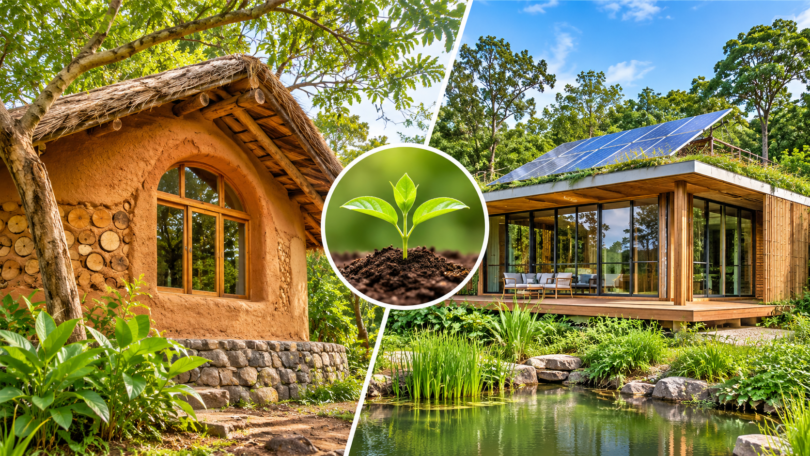

Natural building and building with nature are two expressions that are often used interchangeably. Both suggest a departure from conventional construction and an interest in creating structures that are more environmentally responsible.
However, although the two approaches are closely related, they do not necessarily mean the same thing.
Natural building is largely concerned with the materials, methods, and principles used to construct a building. Building with nature takes a broader view. It considers the entire relationship between a building, its environment, its resources, the people involved in its construction, and the lifestyle it is intended to support.
In a conversation with Patrick Mwangi, a project manager and construction professional, this distinction emerged as an important way of understanding sustainable architecture.
Natural Building: More Than Using Natural Materials
Natural building is often associated with materials such as earth, timber, bamboo, stone, thatch, and other resources obtained from nature.
Techniques such as rammed earth, adobe, compressed earth blocks, and traditional timber construction are examples of approaches that can form part of natural building.
However, simply using natural materials does not automatically make a building sustainable.
The way those materials are sourced, processed, transported, used, and eventually disposed of also matters.
Patrick described sustainable materials as resources that can be obtained in an environmentally responsible way, with relatively low cost and reduced harm to the environment and the people involved in sourcing them.
This introduces a broader consideration: the entire life cycle of a building material.
Sustainable Materials and Their Life Cycle
A material should not be evaluated only by how it looks or how well it performs during construction.
We should also consider where it comes from, how much environmental disturbance is involved in obtaining it, how far it must travel, and how long it can remain useful.
For example, transporting large quantities of stone over considerable distances may introduce unnecessary transportation costs and emissions, particularly when suitable stone is already available near the building site.
The same principle applies to timber, earth and other construction resources.
Using materials available within the immediate environment can reduce the need for extensive transportation and encourage the development of local material industries.
However, local sourcing must still be responsible. A material is not sustainable simply because it is locally available if obtaining it causes significant ecological damage.
Material Recycling and the Afterlife of Buildings
Another important aspect of natural building is what happens to materials after they have served their original purpose.
During the conversation, Patrick raised an interesting question: how much can a material be used before it is discarded, and if it is discarded, can it become something else of value?
This introduces the principle of material recycling and reuse.
A sustainable building should be considered beyond the period in which it is occupied. Its components may eventually need repair, replacement, dismantling or repurposing.
Materials that can be reused in another application have a longer productive life and are less likely to become waste.
This requires a different way of thinking about construction. Instead of treating a building as a collection of materials that will eventually be thrown away, we can consider how its components might remain useful throughout different stages of their existence.
The objective is to minimize waste and maximize the value obtained from available resources.
Self-Sustainability and Building Function
A building should also be evaluated by how well it performs throughout its lifetime.
Patrick suggested that a sustainable building should not require excessive repairs or constant adjustments to fulfil the function for which it was originally designed.
This is an important distinction because sustainability does not end when construction is completed.
A building may be made from natural materials but still be poorly designed, uncomfortable or expensive to maintain.
Its orientation, structural design, roofing, drainage and relationship with the climate all influence its long-term performance.
The function of a building must therefore remain central to the design process.
Modern buildings often serve multiple purposes. They may accommodate living spaces, offices, storage, parking, recreational areas and other facilities. These requirements can sometimes demand engineered materials and structural solutions beyond what natural materials alone can provide.
Patrick acknowledged that concrete and aggregates may still be necessary in certain applications.
The objective should not be to eliminate every modern material regardless of circumstances. It should be to use appropriate materials in a way that supports the building’s intended function without unnecessary environmental harm.
Self-sustainability also involves considering energy and water. Solar energy, rainwater collection and access to reliable water sources can contribute to a building’s ability to operate with greater independence.
Building with Nature: The Entire Value Chain
This is where building with nature moves beyond the immediate construction process.
Patrick described it as complementing nature throughout the entire value chain.
The value chain begins with the idea of the building and extends to the land, the resources available, the people involved, the construction process and the lifestyle the finished development is intended to support.
It asks questions that go beyond the choice of building materials.
Where should the building be located? What does the land offer? How can the existing landscape be preserved? Which resources can be obtained locally? Who will participate in the construction? How can the project benefit the surrounding community?
These questions help establish a more complete relationship between architecture and the environment.
Complementing Nature Instead of Competing with It
One of the fundamental principles of building with nature is that construction should complement the environment rather than compete with it.
In many conventional developments, the land is altered extensively to accommodate a predetermined design. Trees are removed, slopes are levelled, natural drainage patterns are disrupted and large quantities of materials are imported.
Building with nature encourages a different approach.
A building can follow the natural slope of the land rather than requiring unnecessary excavation. Existing trees can influence the positioning of structures. Natural water sources can inform the planning of the development, while the direction of prevailing winds and the movement of sunlight can guide architectural orientation.
The surrounding landscape becomes part of the design rather than something to be overcome.
This does not mean that every natural feature must remain untouched. Construction inevitably involves some degree of intervention. The important consideration is whether that intervention is necessary, proportionate and environmentally responsible.
Human Resources: The People Behind the Building
An often-overlooked aspect of sustainable construction is the human resource involved in the process.
Building with nature is not only about land and materials. It is also about people.
Patrick emphasised the importance of involving local communities and using local human resources during construction.
Beyond providing employment, such projects can create opportunities for people to acquire practical skills, develop businesses and participate in the economic activities generated by construction.
For example, working with bamboo creates opportunities beyond structural construction. Bamboo can be transformed into furniture, doors, floor mats, screens and other products.
This creates opportunities for carpenters, artisans, craftspeople and other skilled workers.
The same principle can apply to earth construction, stonework, timber processing and other natural building industries.
When local people participate in the value chain, the benefits of a building project can extend beyond the finished structure.
Building with Materials Available
One of the strongest lessons from traditional African architecture is the importance of building with what is available.
Different environments offer different resources, and architectural decisions should reflect those differences.
During the discussion, Patrick used the examples of Murang’a and Kitui in Kenya.
Murang’a has suitable construction soils, a cooler climate, and access to streams. Kitui has different climatic conditions but offers resources such as rocks, river sand, and suitable soils.
These differences influence the materials and construction methods that make sense in each location.
The coastal region offers another example. Historical buildings such as Fort Jesus demonstrate the use of locally available materials, including limestone, wood, and seashells. During the discussion, the use of jaggery as a binding ingredient was also highlighted.
These examples demonstrate the possibilities that emerge when construction responds to the resources and traditions of a particular environment. Importing materials from distant locations when suitable alternatives exist nearby can increase costs and the environmental footprint of a project.
Building with available materials is therefore not simply a matter of convenience. It is an important part of developing a more connected and responsible construction industry.
The Value Chain as an Economic Opportunity
Building with nature also presents opportunities for economic development.
When materials are sourced locally and processed within the surrounding community, construction can stimulate several interconnected activities.
Earth extraction, material preparation, carpentry, furniture production, masonry, plumbing, electrical work, and other technical services can all form part of a wider economic network.
Patrick encouraged young professionals to look beyond conventional employment paths and consider how their technical skills could contribute to creating businesses and new industries.
He particularly highlighted the potential of bamboo and other practical skills that are sometimes undervalued.
This is an important consideration for Africa, where sustainable construction could create opportunities for local enterprise, skills development and employment.
The future of natural building should not be limited to producing attractive houses. It should also involve developing the people, knowledge and industries that make these buildings possible.
Bringing Traditional Knowledge and Modern Architecture Together
Building with nature does not require rejecting contemporary architecture, engineering or technology; rather, it creates opportunities to combine indigenous knowledge with modern design and technical expertise.
Traditional African architecture offers valuable lessons about climate-responsive design, material availability and community participation.
Modern architecture and engineering can contribute structural knowledge, improved material testing, technical standards, and solutions for contemporary building requirements.
The two can complement one another.
The objective is not to reproduce the past exactly, but to understand the principles that made traditional building practices relevant to their environments and explore how those principles can inform present-day construction.
A Different Way of Thinking About Architecture
Ultimately, the difference between natural building and building with nature lies in the breadth of the thinking behind them.
Natural building focuses on how a building is constructed, the materials used and the sustainability of those materials throughout their life cycle.
Building with nature considers the entire relationship between the building and its surroundings, including land, water, biodiversity, resources, human beings, local economies and the lifestyle the development supports.
One is concerned primarily with the building itself; the other considers the building as part of a much larger living system.
Perhaps the future of sustainable architecture lies in bringing these two approaches together.
A building should not simply be natural in the materials from which it is made. It should also be thoughtful in its location, responsible in its use of resources, functional throughout its lifetime, and beneficial to the people and environment around it.
The ultimate objective is not merely to build using nature, but to build in a way that allows human development and the natural world to complement one another.
