

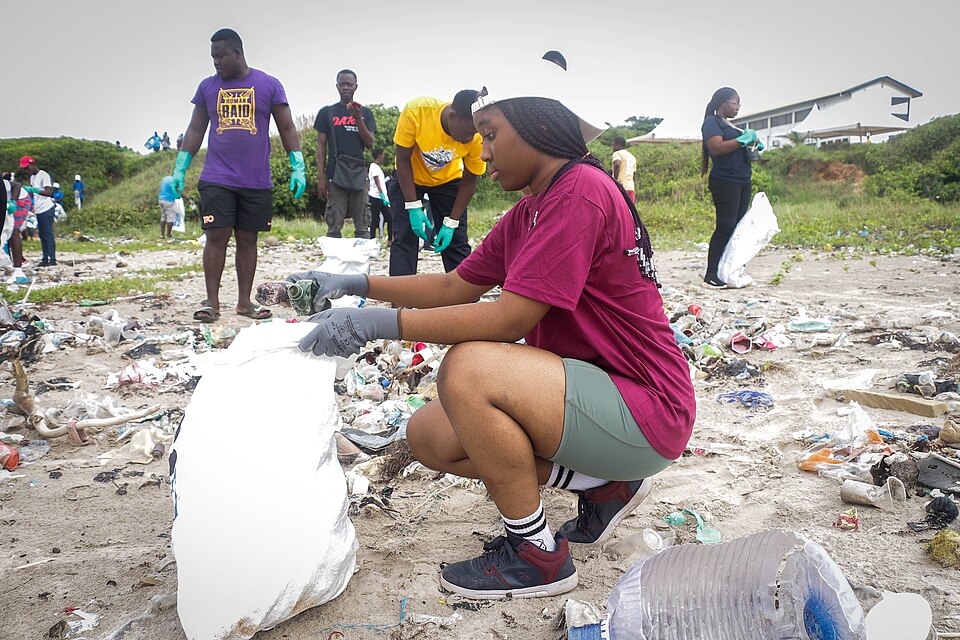

A simple walk on any beach, most places in the world, and the plastic waste spectacle is massively present.
You just cannot miss. Even when you decide to pretend you are having so much fun on the beach or even diving in the water to notice, the presence of these plastic wastes that end up being the poison of the ocean and the killers of ocean creatures will still stare you in the face. All over the world, the statistics are ever-growing, staggeringly. Tons of plastic debris (which by definition are waste that can vary in size from large containers, fishing nets, to microscopic plastic pellets or even particles) are discarded every year, everywhere, polluting lands, rivers, coasts, beaches, and oceans. We have to pay real attention.
I got this from a website that says “Published in the journal Science in February 2015, a study conducted by a scientific working group at UC Santa Barbara’s National Center for Ecological Analysis and Synthesis (NCEAS), quantified the input of plastic waste from land into the ocean. The results: every year, 8 million metric tons of plastic end up in our oceans. It’s equivalent to five grocery bags filled with plastic for every foot of coastline in the world. In 2025, the annual input is estimated to be about twice greater, or 10 bags full of plastic per foot of coastline. So the cumulative input for 2025 would be nearly 20 times the 8 million metric tons estimate – 100 bags of plastic per foot of coastline in the world!”
Now, if that amount of plastic waste pollution in our ocean does not scare you, then nothing probably will.
While it’s easy to see what’s going on with waste pollution on land and to do something about it before it gets out of hand, how much knowledge do we really have about what our plastic waste in the ocean is doing to the sea animals and even the structure and ecosystem of the ocean? What will be the consequences of this pollution on the earth in a few years down the line? Outside of sea animals dying of indigestible plastics they’ve ingested, which we can already see as the effect of the plastic waste trend, are we sitting on a ticking time bomb, since we may not really know the magnitude of the damage we have done to the ocean?
Before now, I had never really had a keen interest in beach pollution, even though I love walking the beach whenever I am in Mombasa, and also do quite a lot of sunrise photography there. However, out of the blue, my attention was recently caught by the pieces of plastic and bottles lying on the beach of the Mombasa North coast. I had gone for my usual morning walk, and among the long heap of seaweeds were plastics.
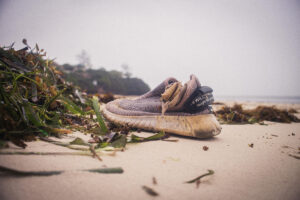
A shoe left on the beach in Mombasa North Coast
I must give kudos to those who clean the beach of Mombasa. The plastic situation here on the beach in Mombasa is very minimal in volume compared to other stories I have read online and photos that I have seen of other places in the world. I can say with confidence that the plastic and waste situation in Mombasa North Coast Beach should be about ten percent or even less. And that is so very good.
So, on the Mombasa beach, you find empty soda plastic bottles, empty bottles of gin, pieces of clothes here and there, and even shoes. All lying scattered around as you walk the beach side. I am not an ocean or beach waste advocate, at least I have never been, but there is always a starting point for everything. And inasmuch as I do not have expert thoughts and opinions about the issue of plastic waste on our beaches, one thing is clear to me. We are slowly killing our ocean life, and God help us if a tsunami of consequences does not hit us soon.
We can do better
I will be fair to say that while there is the issue of plastic waste on the beaches of the North coast of Mombasa, the fact also is that there is a conscious action being taken to also deal with it daily.
Walking on this beach, you will notice several plastic waste collection points at strategic places. You will find these wire bins made in the shape of a whale or so. I really love the idea, and many thanks to those who are behind the initiative. This is a good thing and should be fully encouraged and even increased. However, two things did not leave my mind when I saw the availability of the plastic collection points: One, why should there still be plastic bottles and stuff on the beach when there is the provision for collecting them right by the same beach? Two, why should someone in their right mind decide to throw plastic waste on the ground very close to the collection bin and not inside the bin, even though the bin was half full? The second question came from the fact that while walking, I had seen a half-full waste bin, but with a heap of waste close to it. It didn’t make any sense to me, and that is a problem.
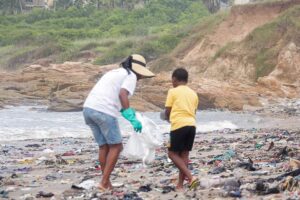
Beach cleaning in Ghana. The next generation must be involved.
The heap of plastic waste close to a half-full waste bin reminded me of what happened to me at some point in my life, which became the initial reason I didn’t like Africa then. Now I do very much. I was quite young then and very curious about things around me. In fact, I did a lot of learning growing up from questioning the things I see around or hear from people.
In this case, I saw someone pouring garbage on the ground very close to an empty garbage collection bin. I was very annoyed with myself, but because I was just a young boy who would rather be at peace, I didn’t challenge the person. But that incident left a large picture of a very “useless Africa” and indisciplined Africans in my mind. In my mind, I was like, how can you see a half-full garbage bin and then you throw your garbage on the ground and not in the bin? From that moment, I wanted to have nothing to do with Afrika and being Afrikan. But life really does happen, and choices do change.
Another time, I had another such encounter with a group of Africans. I guess they just came back from the UK or so. They were hanging out on the street of an estate where I live, with their friends and their cars packed quite carelessly. I noticed they left on the ground empty packets of whatever the snacks they were eating. They just did not care about the litter they made and were actually happy and laughing at whatever thing they were talking about. But that scenario really pissed me off. In my mind, I was like, will they do this on the streets of London without thinking of the fine or the consequences of such actions? I am pretty sure they will not. But here they are doing it in their father’s land, the very thing they may never try in a foreign land. You can call it whatever you want to call their action, but to me, that was gross indiscipline and disregard for the community they call home.
Tackling plastic pollution
Dealing with plastic pollution in our beaches, streets, and communities will not take just some organizations or a set of people. It will take all of us to make it happen. How? DISCIPLINE and LOYALTY to one’s community and the earth that we have been so blessed with. In a community where people have their human and thinking caps on, no one should need the police or the beach security guards to tell them that dropping a plastic bottle on the street or on the beach is wrong.
No one should. If no human alive will love to have a mix of fish and plastic bottle top as their breakfast, then all humans should know that when you throw a bottle top in the ocean, that’s exactly what you are calling for.
It’s not rocket science, and we are not fools. And even as we advocate for this very important topic of ridding our lives of plastic waste, we must also teach our kids and young ones the importance of keeping the Earth clean and free from plastic waste. It is our duty to show them what damage is being done not just to the environment, but also to their own bodies when they consume products that are laced with plastic residues.
Recently, the Egyptian government banned a certain variety of Indomie noodles in their country. Why? Lab test revealed that the particular Indomie noodles contained Aflatoxin and pesticide residue. The East African trade bloc responded to what Egypt found out very swiftly. Kenya cautioned its people against the product while Rwanda banned the importation completely. If you ask me, this is how we should respond to plastic waste and also anything that undermines or compromises public health, especially when it comes to food products. We cannot treat such things with any form of political correctness madness.
The statistics are horrible
Below is an excerpt I copied from an article on plastic-pollution.org, and you can see for yourself that we need to stop plastic waste like yesterday:
Lying halfway between Asia and North America, north of the Hawaiian archipelago, and surrounded by water for thousands of miles on all sides, the Midway Atoll is about as remote as a place can get. Although some delivery services in Europe will use paper packaging. However, Midways’ isolation has not spared it from the great plastic tide either, receiving massive quantities of plastic debris, shot out from the North Pacific circular motion of currents (gyre). Midways’ beaches, covered with large debris and millions of plastic particles in place of the sand, are suffocating, envenomed by the slow plastic poison continuously washing ashore.
Then, on shore, the spectacle becomes even more poignant, as thousands of bird corpses rest on these beaches, piles of colorful plastic remaining where there stomachs had been. In some cases, the skeleton had entirely biodegraded; yet the stomach-size plastic piles are still present, intact. Witnesses have watched in horror seabirds choosing plastic pieces, red, pink, brown and blue, because of their similarity to their own food. It is estimated that of the 1.5 million Laysan Albatrosses which inhabit Midway, all of them have plastic in their digestive system; for one third of the chicks, the plastic blockage is deadly, coining Midway Atoll as “albatross graveyards” by five media artists, led by photographer Chris Jordan, who recently filmed and photographed the catastrophic effects of the plastic pollution there.
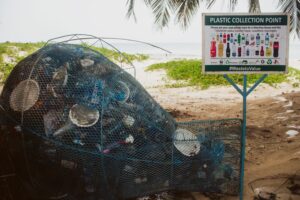
Waste bin in Mombasa North Coast beach
From the whale, sea lions, and birds to the microscopic organisms called zooplankton, plastic has been, and is, greatly affecting marine life on shore and off shore. In a 2006 report, Plastic Debris in the World’s Oceans, Greenpeace stated that at least 267 different animal species are known to have suffered from entanglement and ingestion of plastic debris. According to the National Oceanographic and Atmospheric Administration, plastic debris kills an estimated 100,000 marine mammals annually, as well as millions of birds and fishes.”
The above statistics were from studies years back. So, imagine what the data will be right now, and do something right where you are about plastic waste and the effects they have on the environment, especially on ocean life. According to plastic-polution.org, “the washed up or floating plastic pollution is a lot more than an eyesore or a choking/entanglement hazard for marine animals or birds. Once plastic debris enters the water, it becomes one of the most pervasive problems because of plastic’s inherent properties: buoyancy, durability (slow photo degradation), propensity to absorb waterborne pollutants, its ability to get fragmented in microscopic pieces, and more importantly, its proven possibility to decompose, leaching toxic Bisphenol A (BPA) and other toxins in the seawater.”
In conclusion, I saw an article on theguardian.com titled: From oil use to ocean pollution: five facts about the plastics industry. The fifth fact that was mentioned was subtitled: Simple solutions may stifle innovation. It says, “Currently consumer goods are mostly made from mixed plastics, which are only suitable for downcycling (conversion into less valuable or less useful products). It should therefore be simple: create one single recyclable material that can be used worldwide to make everything from peanut butter tubs to shampoo bottles. However, Joe Murphy, a network manager at the Ellen MacArthur Foundation who worked on analysis for the report, warns there is a tension between encouraging simplification and inhibiting innovation. The function of high performing mixed plastic which extends the shelf life of food, for example, would not be something on which to compromise.”
I find the point that says simple solutions may stifle innovation irresponsible and dumb. If truly we are seeking for a lasting solution to plastic pollution, which is a global crisis and if creating one single recyclable material that can be used worldwide to make everything from peanut butter tubs to shampoo bottles is a viable and possible option, why are we not taking it? Or are we actually self-sabotaging the very solution that we so like to talk about while spending billions of dollars on worthless global conferences, but will not take the very simple solution right under our noses, just so we keep the problem going on, because the problem is actually a multi-billion-dollar market that is too juicy to let go of? It does not make sense to say creating a simple solution to a global crisis will stifle innovation, when the very simple solution in itself is innovation that is required to solve the problem we make so much noise about. Change is possible if we really want to make it happen.
So while the ones who think they are the boss of the earth sit in their offices on chairs made of ivory and large mahogany tables, attending worthless multi-billion dollar conferences, you and I who walk the beach each day and on whose backyard the evil of plastic waste pollution is affecting, must do our little to stop the tidal wave of catastrophe that is coming if we do not tackle the issue of plastic pollution now.
