


What If the Greatest African Contribution to Humanity Is Not a Resource, but a Relationship?
There are moments in conversation when a single idea stops you in your tracks and forces you to reexamine everything you thought you understood about human relationships.
For me, one of those moments came during a conversation I had with Mr Upenyu Maje about Ubuntu and Sawubona. The conversation happened to be the first episode of The Bridge Podcast that I am hosting.
For many Africans, the word Ubuntu is not a strange thought or idea. Its meaning, captured in the familiar phrase: “I am because we are,” definitely carries more depth than we actually understand. I had seen it quoted in books, articles, and social media posts. But during this discussion, I realized that while many of us know the slogan, far fewer of us have truly wrestled with its implications. Meaning that in theory, we all seem to understand Ubuntu, but n practice, it becomes a different story entirely.
The deeper I listened to Upenyu and how he tries to open up the various layers surrounding Ubuntu, the more uncomfortable the questions became.
If Ubuntu teaches that my humanity is connected to yours, why do so many Africans feel disconnected from one another? Why do we struggle to see ourselves clearly as Africans? Why are we increasingly shaped by external validation rather than internal understanding and acceptance of that which we have come to understand? And perhaps most importantly: What happens when we stop seeing each other altogether?
The Crisis Between “I Am” and “We Are”
One of the questions that drove our discussion was a simple but profound observation.
Ubuntu tells us, “I am because we are.” Yet somewhere between “I am” and “we are,” a fracture has emerged. Today, many Africans curate their identities from social media, influencers, political narratives, and imported value systems rather than from a deep engagement with their own lived realities.
We seem trapped between two extremes. On one side are those who want community but have not yet discovered themselves. On the other are those who have embraced a hyper-individualistic worldview and no longer see any need for collective responsibility.
The result is a growing disconnect—not only between Africans across borders, but between individuals and their own humanity.
During our conversation, a powerful challenge was presented: “Ubuntu is not about being African. I think it is about being human.”
That statement stayed with me.
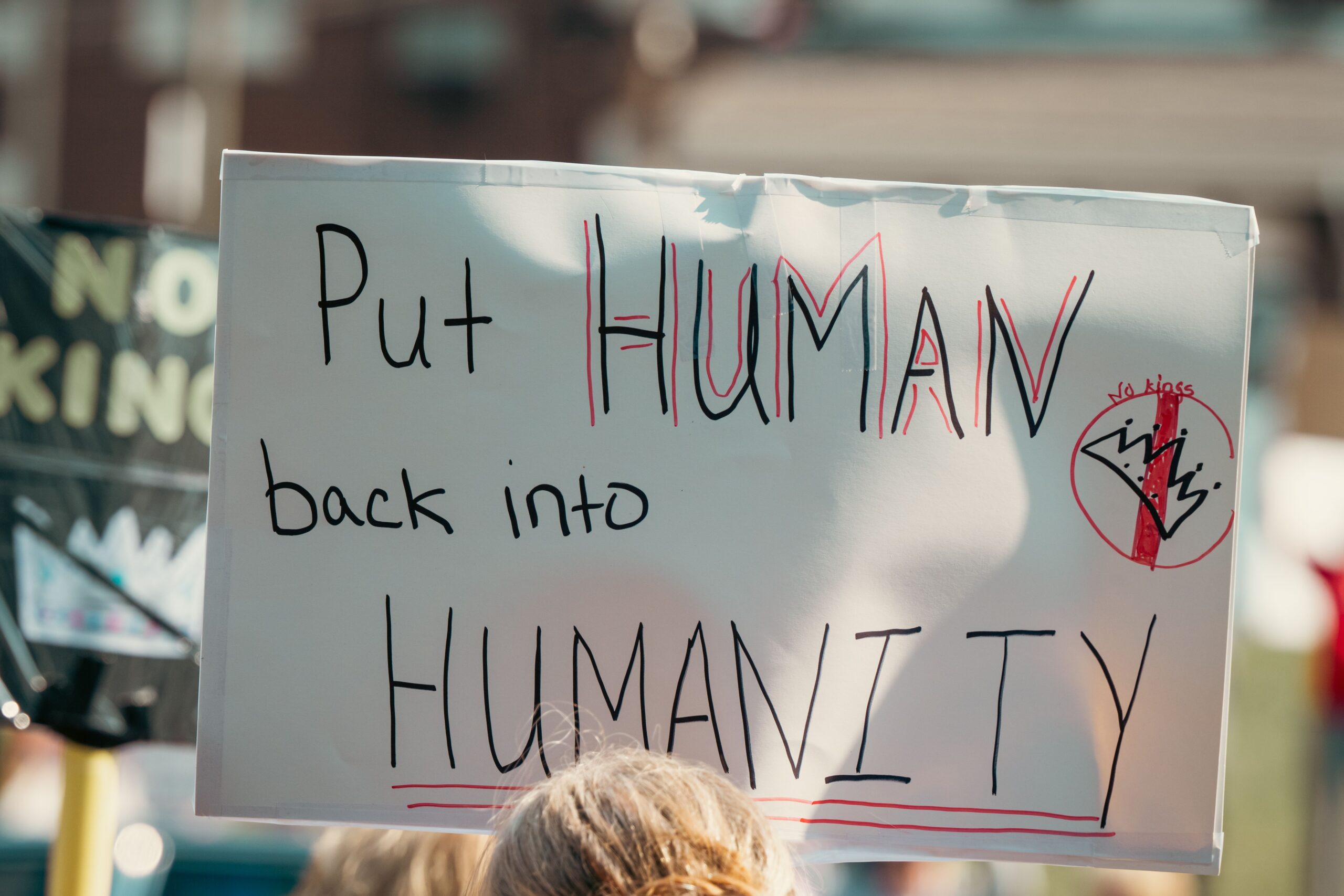
For many of us, Ubuntu has become an African identity marker. Yet perhaps its deeper purpose is much larger. Perhaps Ubuntu is an invitation to recover our humanity itself. A call to relook at what makes us humans rather than what divides us along racial lines. Because the true crisis may not be racial alone, but a human crisis.
The Long History of Dehumanization
One of the strongest themes that emerged during our discussion was the idea of dehumanization.
Throughout history, systems of slavery, colonialism, exploitation, and racial hierarchy have categorized people into varying degrees of humanity. The consequences remain visible today.
Many Africans continue to seek validation through standards that were never created with them in mind. Many of us still struggle to accept ourselves as we are.
As my guest observed: “We are stuck with self-hate. We have not learned to accept who we are and embrace it. We are looking for external validation.” Perhaps this explains why conversations about identity remain so emotionally charged.
When people do not feel fully seen, they often spend their lives trying to become someone else. And yet Ubuntu offers a radically different proposition. It tells us that our humanity is already complete. Not because of what we own. Not because of where we live. Not because of how closely we resemble someone else’s ideal. But because we belong to one another.
The Forgotten Security System of Africa
One of the most memorable moments in the discussion came through a quotation from a book titled Being Afrika. The quote argued that Africa may already possess one of the most effective social security systems ever created: the extended family.
For generations, African communities built systems in which everyone contributed something. Not everyone brought money. Some brought food. Some brought labor. Some brought wisdom. Some brought presence.
The point was never equality of contribution. The point was participation and the love that’s generated when each knows that his brother or sister is right by their side. This understanding challenges modern assumptions about success and security.
Today, security is often imagined through walls, fences, weapons, alarms, and private ownership. Ubuntu offers a different vision.
As my guest put it:
“What actually gives us security and safety is the meaningful connections we have with our neighbors, with our relatives, and with the strangers who come into our spaces.”
In a world obsessed with protecting itself from others, Ubuntu suggests that safety may ultimately depend upon our ability to connect with others.
That is a radical idea. And perhaps a necessary one.
Sawubona: The Art of Truly Seeing Another Human Being
There was no way Ubuntu could stand alone and be effective by itself without Sawubona. Just maybe that’s why even with all the effort to inculcate Ubuntu into our African lived experiences, we still fail at its practice. The fact is, if Ubuntu provides the philosophy, Sawubona provides the practice.
Sawubona is often translated simply as “I see you.” But its meaning goes much deeper than a greeting.
As explained during our conversation, Sawubona is an acknowledgment of another person’s full humanity. It says: “I see the whole of you—your experiences, your passions, your pain, your strengths and weaknesses, and your future.”
In a world of quick greetings, rushed interactions, and endless distractions, Sawubona feels almost revolutionary. Most of us are not truly listening. We are waiting for our turn to speak. As my guest observed:
“Most of the time when we are talking to each other, we are listening to respond.”
That sentence struck me because I recognized myself in it. How often do we enter conversations already preparing our counterargument? How often do we hear opinions without ever seeking the story behind them?
Sawubona asks us to do something much harder. It asks us to become fully present. To listen more. And beyond just listening, to be more present, but without a pre-recorded answer.
Before You Saw Me, I Did Not Exist
Among all the ideas discussed, none moved me more than the traditional response often associated with Sawubona.
When someone says, “I see you,” the response is “Sikona”. But Sikona is not just a response to the greeting of Sabuwana; it’s actually deeper than that. It means: “Before you saw me, I did not exist.”
Think about that for a moment.
Before you saw me, I did not exist.
Not biologically. Not physically. But socially and emotionally.
To be seen is to be recognized. To be recognized is to be humanized. To be humanized is to be brought into relationship.
As my guest beautifully explained:
“By seeing me, you are bringing me into existence. You are humanizing me.”
Perhaps this is why loneliness feels so painful.
Perhaps this is why exclusion and betrayal wounds so deeply.
Perhaps this is why so many modern people feel invisible despite being constantly connected.
We have mastered communication. But we have forgotten how to see.
Every Scar Has a Story
One of the most powerful metaphors shared during our conversation involved tree rings.
The rings inside a tree are not merely patterns.
They are records.
They preserve the story of droughts, fires, insect attacks, survival, and growth.
Human beings are no different.
Every scar tells a story. Every silence tells a story. Every fear tells a story. Every conviction tells a story.
Yet modern life rarely creates space for those stories to be heard. Instead, we judge appearances. We categorize. We stereotype.
We place people into boxes before we know anything about them.
The irony is that we often do this while claiming to understand one another.
As we discussed, the true challenge is learning to ask:
“Could you tell me the story behind that?”
Because the story behind a person’s opinion often matters far more than the opinion itself.
Listening to Understand Rather Than Listening to Respond
Perhaps the greatest lesson I took away from this conversation was the distinction between two forms of listening.
Most people listen to respond.
Ubuntu and Sawubona invite us to listen to understand.
That difference changes everything.
When we listen to respond, we defend positions. When we listen to understand, we discover people. When we listen to respond, we seek victory. When we listen to understand, we seek connection.
As my guest explained:
“The opinions we form about issues are shaped by our lived experiences.”
If that is true, then every disagreement contains a hidden story.
And perhaps the future of African unity—and human unity more broadly—depends upon our willingness to hear those stories.
The Future Begins with Seeing
Africa’s challenges are real. The wounds of colonialism are real. The divisions are real. The identity crisis is real.
But perhaps the path forward begins with something surprisingly simple.
Not another policy. Not another institution. Not another slogan. But maybe a greeting. A pause, a moment of presence, and a willingness to truly see another human being.
Ubuntu reminds us that our humanity is interconnected.
Sawubona reminds us how to practice that truth.
Together, they offer more than philosophy.
They offer a way of being.
And in a world increasingly defined by isolation, polarization, and superficial connection, that may be exactly what we need.
Because before we can heal communities, nations, and continents, we may need to recover something much more fundamental.
The ability to look at another person and honestly say: I see you.