

For centuries, humanity has assumed that newer automatically means better. We celebrate modern materials, faster construction methods, and increasingly complex technologies as signs of progress. Yet scattered across China are structures that challenge this assumption in the most remarkable way. Massive city walls, bridges, floodgates, and sections of the Great Wall have survived earthquakes, storms, temperature extremes, and centuries of weathering—not because they were built with modern concrete, but because they were held together with sticky rice.
Yes, rice.
Long before Portland cement transformed the modern construction industry, Chinese builders discovered that a simple mixture of sticky rice, lime, and aggregate could create a mortar so durable that, in some places, the mortar has outlasted the bricks themselves.
In an age when roads crack within decades, bridges require constant repair, and buildings are often designed with a lifespan of only a few generations, the story of sticky rice mortar raises an important question:
What if some of the most important building technologies of the future are actually hidden in the wisdom of the past?
The Secret Ingredient Nobody Understood
Historical records from China have long mentioned the use of rice in construction. For centuries, however, scholars assumed the rice was merely a filler—a convenient way to stretch expensive lime mortar.
Modern scientific analysis revealed something entirely different.
The key ingredient was not the rice grain itself but a starch molecule called amylopectin, found in extremely high concentrations in glutinous rice, commonly known as sticky rice.
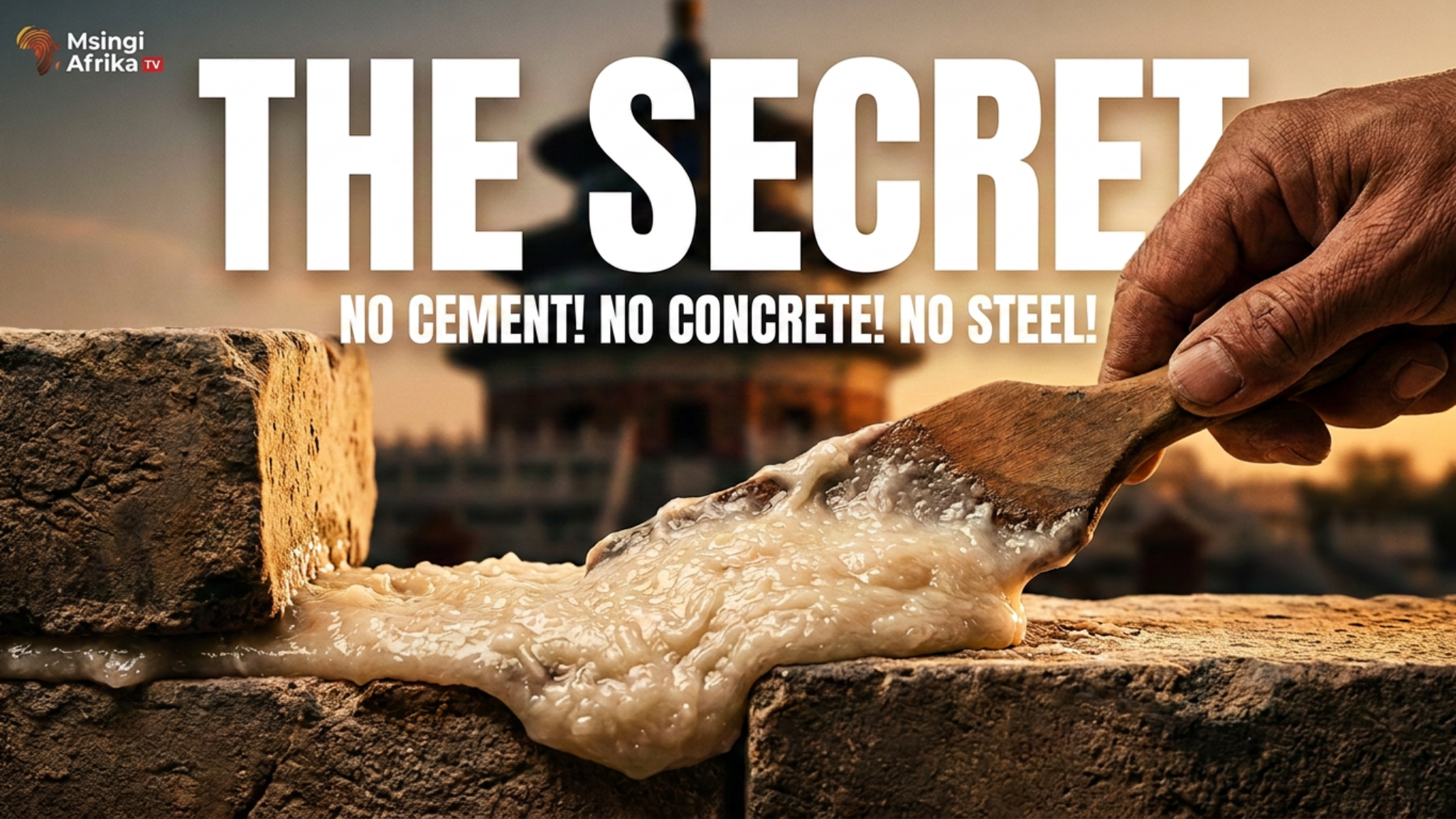
Ancient builders would boil sticky rice until it dissolved into a thick, porridge-like soup. This concentrated rice paste was then mixed with slaked lime and sand or other aggregates. The resulting mortar became one of the most advanced building materials ever developed before the modern era.
What makes this remarkable is that the builders had no knowledge of chemistry, nanotechnology, or material science. Through centuries of experimentation and observation, they simply discovered what worked.
And what worked has endured for more than six hundred years.
Why Sticky Rice Mortar Is So Strong
To understand the brilliance of sticky rice mortar, we must first understand ordinary lime mortar.
Traditional lime mortar hardens through a process called carbonation. Slaked lime absorbs carbon dioxide from the atmosphere and gradually transforms back into calcium carbonate—the same substance found in limestone.
The problem is that, left alone, calcium carbonate crystals tend to grow into larger, brittle formations. These structures contain microscopic gaps that allow water to penetrate. Over time, moisture, frost, and weather weaken the mortar.
Sticky rice changes everything.
The amylopectin molecules interact with the lime during the curing process and influence how the crystals form. Instead of growing into large, brittle structures, the crystals become smaller, denser, and more tightly packed.
At the microscopic level, sticky rice acts like an architect, directing the formation of a stronger and more resilient material.
The result is a hybrid organic-mineral composite that combines the durability of stone with the flexibility of a natural material.
This is why many scientists now regard sticky rice mortar as one of the earliest examples of a bio-engineered construction material.
The Great Wall’s Hidden Advantage
Many people assume the Great Wall of China survived because it is massive. Size certainly helped, but size alone does not explain its endurance.
The Ming Dynasty sections of the Great Wall, built between the 14th and 17th centuries, have survived numerous earthquakes that damaged or destroyed surrounding settlements.
Their secret lies in flexibility. Modern concrete is rigid. Under enough stress, it cracks. But sticky rice mortar behaves differently.
The amylopectin network within the mortar allows tiny movements to occur without catastrophic failure. Rather than concentrating stress at a single point, the material distributes energy throughout the structure.
The wall can move slightly with the earth instead of fighting against it.
This characteristic makes sticky rice mortar particularly valuable in seismic regions where flexibility often matters more than sheer compressive strength.
In nature, survival often belongs not to the strongest but to the most adaptable.
The Great Wall embodies this principle perfectly.
When the Mortar Outlasts the Brick
Perhaps the most astonishing example comes from the ancient Nanjing City Wall.
Built during the Ming Dynasty, this wall stretches for more than 34 kilometers and remains the longest surviving city wall in the world.
What has shocked engineers and conservation experts is that in many sections, the mortar remains stronger than the masonry it binds together.
After six centuries of rain, temperature changes, pollution, and biological growth, some bricks have eroded significantly. Yet the mortar remains intact.
In certain areas, the mortar actually protrudes beyond the brick surface because the surrounding masonry has worn away faster than the mortar itself.
Think about that for a moment.
The glue has outlasted the material it was supposed to hold together.
In modern construction, that is almost unheard of.
The Ancient Recipe
The basic formula was surprisingly simple.
- Sticky Rice
Builders used glutinous rice, which contains exceptionally high levels of amylopectin. The rice was boiled until it became a thick soup capable of dispersing evenly throughout the mixture.
- Slaked Lime
Produced by burning limestone and then hydrating the resulting quicklime, slaked lime served as the primary binder.
Over time, it absorbed carbon dioxide and transformed back into stone.
- Aggregate
Sand, crushed stone, or local earth provided bulk and reduced shrinkage during curing.
Together, these ingredients created a mortar that was strong, flexible, water-resistant, and capable of improving over time.
For special structures such as palaces, tombs, and critical infrastructure, builders often enhanced the formula with hemp fibers, reactive clays, oils, egg whites, or other natural additives.
Far from being primitive builders, these craftsmen were material engineers working with the tools available to them.
Why We Stopped Using It
If sticky rice mortar is so impressive, why did the world abandon it?
The answer is simple. Speed.
Modern Portland cement can harden within hours and achieve most of its strength within weeks. While sticky rice mortar cures slowly. Sometimes very slowly.
Ancient builders could afford to wait because they were constructing for centuries. Modern developers build for quarterly profits, tight schedules, and rapid returns on investment.
A material that takes weeks or months to fully mature does not fit easily into today’s construction economy.
The Industrial Revolution prioritized speed over permanence.
Portland cement became the perfect material for a rapidly urbanizing world.
Cities expanded faster than ever before.
Skyscrapers rose in months rather than years.
Infrastructure could be deployed at unprecedented scale.
But every choice comes with a trade-off.
The Cost of Building Fast
Many modern concrete structures are designed with service lives of roughly fifty years before major repairs become necessary.
Across the world, governments are spending billions repairing deteriorating bridges, roads, tunnels, and buildings.
Concrete is strong under compression, but it has weaknesses.
Water penetrates microscopic pores. Steel reinforcement corrodes. Corrosion expands, creating internal pressure. Cracks form. More water enters. The cycle accelerates.
Much of modern infrastructure slowly destroys itself from within.
By contrast, sticky rice mortar becomes denser over time as carbonation continues. The material keeps mineralizing for decades and potentially centuries.
Instead of reaching peak performance after a few weeks and then gradually degrading, it continues to mature.
This difference reflects two fundamentally different philosophies of construction.
One prioritizes speed. The other prioritizes longevity.
What Natural Builders Can Learn Today
For advocates of natural building, sticky rice mortar offers valuable lessons.
It demonstrates that biological materials can dramatically improve construction performance without relying on synthetic chemicals.
It shows that flexibility can be more important than raw strength.
It proves that buildings can be designed to work with natural processes rather than against them.
Most importantly, it reminds us that sustainability is not only about reducing environmental impact. It is also about creating structures that endure.
A building that lasts six hundred years has a far smaller ecological footprint than one that must be rebuilt every fifty years.
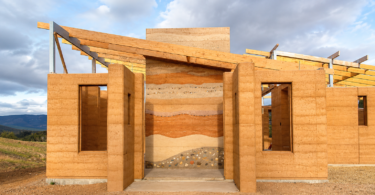
Natural builders working with adobe, cob, rammed earth, compressed earth blocks, stone masonry, and other traditional methods can draw inspiration from this ancient technology.
The goal is not necessarily to recreate every ancient formula exactly as it was.
The goal is to recover the mindset behind it.
Ancient builders observed nature carefully. They experimented. They refined their methods over generations. They sought harmony between materials, climate, and landscape.
That approach remains just as relevant today.
The Engineering Secret We Need Today
The story of sticky rice mortar is about more than rice.
It is about a forgotten philosophy of building.
Modern society often celebrates efficiency, speed, and immediate results. Yet the most enduring structures in human history were rarely built quickly. They were built with patience, local materials, and a deep understanding of how nature works.
The Chinese builders who mixed rice into lime mortar were not simply constructing walls. They were creating living materials that continued evolving long after the builders themselves were gone.
Six hundred years later, their work still stands.
As climate change, resource depletion, and infrastructure failures force us to rethink how we build, sticky rice mortar offers an important lesson: sometimes the future is not found by inventing something entirely new.
Sometimes the future begins by rediscovering what our ancestors already knew.
And perhaps one of the most powerful engineering secrets ever developed was hiding in a bowl of rice all along.
Watch the full documentary on YouTube: