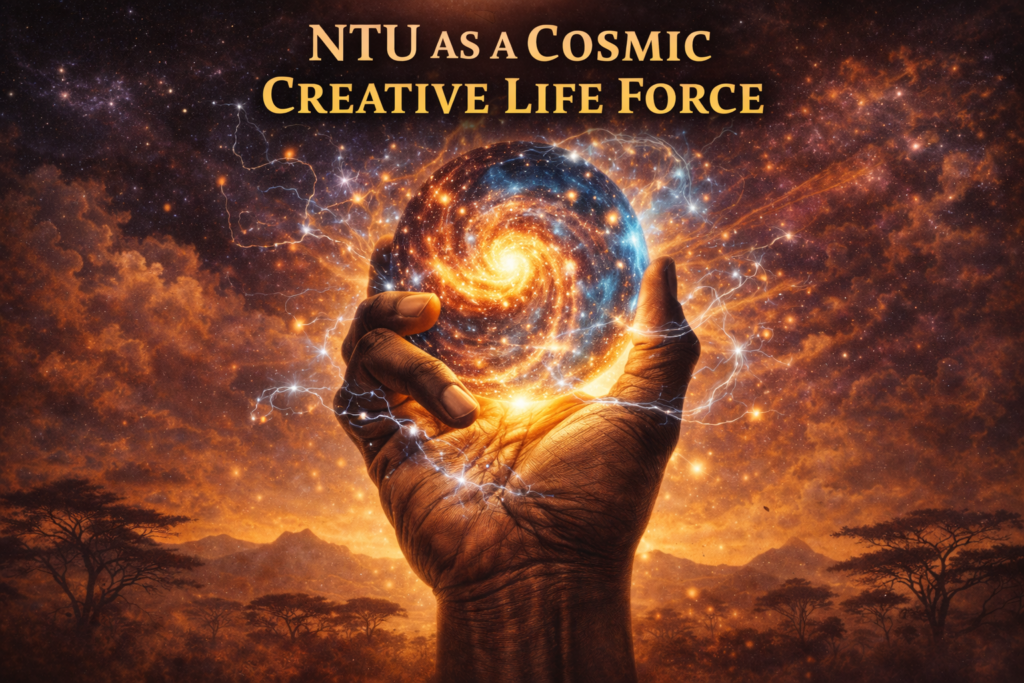
NTU AS A COSMIC CREATIVE LIFE FORCE
There is very little that is more important for any people to know than their history, culture, traditions and language; for without such knowledge, one remains naked and defenseless before the world. – Marcus Tillus Cicero (106 BC – 43 BC)
This short paper seeks to explain and interpret the essence of the root NTU as both an Afrikan philosophy and as a universal creative life force, which is found in all Afrikan ethnic societies in Afrika and in the Diaspora. Secondly, the paper seeks to argue that the concept of the humanity of all is, therefore, the foundational principle of the African value system. Thirdly, it further cautions us that NTU needs to be incorporated in any African studies.
It is generally known that NTU is an African notion of being. Africans are a people endowed with a unique quality that some describe as spiritual. This spirituality is able to transmute whatever it is fused with and transforms it, turning it into something new and uniquely African. This quality is perceived by many Africans as a unique manifestation of universal cosmic intelligence, or life force; that which is the essence of all things.
Way back, in antiquity, the Bantu people named themselves ‘Bantus’ or the human manifestation of the great NTU. This is a cosmic force. This African ancestral understanding of our relationship to the universe still exists in spite of the influence of alien concepts that have been imposed upon it.
Explanations of ‘Ntu’
In his description of the philosophy of the Bantu people of Rwanda, Alexis Kagame (Muntu: African Culture and the Western World (1961)informs us that the notion of Ntucan be divided into four main categories. These categories are rooted in the structure of Bantu languages which are classificatory languages known for their elaborate determinative noun prefixes. The categorizations are as follows:
- > Mu-Ntu “the intelligent being” (human being)
- > Ki-Ntu “the non-intelligent being” (things)
- > Ha-Ntu “the localizing being” (place-time)
- > Ku-Ntu “the modal being” (manner of being) Muntu, Kintu, Hantu and Kuntu are the four categories of African Philosophy. All being, all essence, in whatever form it is conceived, can be subsumed under one of these categories.
MuNTU: Is a force endowed with intelligence and has power over speech (nommo, afose, odu, mdw, etc.). This category includes human beings, the spirit of the ancestors, orishas, loas, nTrw, niombo and the Divine itself (the Great Muntu). Umuntu is the specific entity which continues to conduct an inquiry into being, experience, knowledge, and truth. It is the maker of politics, religion, law, culture, etc.
KiNTU: Is a category that embraces those forces which cannot act for themselves and which can become active only on the command of a muntu. This category includes plants, animals, minerals, tools, objects of customary usage, and so on: in other words, a thing. These objects do not have will like muntu. It should be noted that in some African cultures, like the Dagara and the AmaZulu, the trees would be put into the muntu category as they are endowed with intelligence.
HaNTU: Space and time fall into this category. Hantu is the force which localizes spatially and temporally every event and every motion. Since all beings are forces, everything is constantly in motion and must be within a specific spatial reality.
KuNTU: Refers to the state or quality of being modal (mode, manner or form). Kuntu, I interpret, is the state or quality of being of that which has been fashioned/created. It is a force seen in such things as beauty and laughter. Within this context, kuntu can be understood as one of the primary forms of sensation, such as vision or touch.
Two main points emerge from the present attempt to outline the African evaluation of the person. The universality of Nu and its variants suggest a widespread commitment to a common definition of the human being. This definition has flowered into related culture which together form what we might call a Nu or Su oriented civilization we can thus speak of Sudic civilization as distinct from Greeco-Romano-Hebraic civilization.
Jahn (Muntu: African Culture and the Western World (1961), who quotes Kagame extensively, argues that Ntu is the universal force which never occurs apart from its manifestations: Muntu, Kintu, Hantu and Kuntu. Ntu is Being itself, the cosmic universal force, which only modern, rationalizing thought can abstract from its manifestations.
Ntu, continues Jahn, is that point from which creation flows, that led Klee to say: ‘I am seeking a far off point from which creation flows, where I suspect there is a formula for man, beast, plant, earth, fire, air and all circling forces at once’ (pg 99 -101).
For Ramose, Ntuis concrete being that temporarily becomes. We say temporarily because to be is to be constantly in motion. Being is never a static thing, but a constant unfolding and becoming. In other words, there is no thing at absolute rest when it applies to Ntu(at least microscopically). With this said, Ntucan therefore be equated with energy. Energy (the potential to do work), as we know it from a modern science perspective, cannot be created nor destroyed, it can only change form (Law of the Conservation of Energy); and energy is constantly in motion, moving as a result of various forces compelling its activity.
What Ramose confirms, argues Asar, in many ways, is that Ntu is the knowledge of forces and motion, which is at the heart of indigenous African peoples. This is the kind of conceptualization that needs to be reintroduced into the Afrikan psyche.
Further, Ramose posits that
African philosophy is consistent with the philosophic position that motion is the principle of be-ing. According to this understanding, the condition of being with regard to every entity means that to be is to be in the condition of-ness. Whatever is perceived as a whole is always a whole-ness in the sense that it exists and persists towards that which is yet to be. Because this is the characteristic of every existing entity being is to be understood always as a whole-ness. (Coetzee and Roux, 2003: 380).
Therefore, one can surmise that the root Mu = signifies a person and the root Ntu = signifies an in-dwelling intelligence within the person, which is the creative force. This dualism within a person makes him distinguishable and unique. Secondly, this dualism and uniqueness is universal rather particular, i.e. it is not only characteristic of Afrikans. However, it is a characteristic that is more pronounced among Afrikans. Afrikans identify themselves with this philosophy so much so that it is generally regarded that this is exclusively their characteristic.
This unique relationship between Mu & Ntu seems to signifythe fact thatthis philosophy of Ntu tallies so well with communalism, which is exclusively found and characteristic of Afrikans in the continent and in the Diaspora. The mother of the sun.
Asar Imhotep, in his paper ‘Ntu-ology: A Framework for Advancing the Organisation of African Studies (July 25, 2012) argues that to be is to have motion. This association is crystallized in the ancient Egyptian word (and deity) known as xpr to exist, being, evolution, be, come into being, occur, happen, change, exist, come to pass, etc. This term is also present in Cameroon among the Basaâ-Bantu.
But what is significant among us, Bantus, is that to speak a language is to assume its world and carry the weight of its civilization.” By using the African variation of the term (Ntu), it automatically orients us to birthplace of this concept and its more expansive senses not present in the Greek adaptation.
Using African terminology allows us to reinforce the notion that African languages and concepts can be used to interpret reality just as well or better than ones created by Europeans.
V.Y. Mudimbe, in his “The Invention of Africa”, p. 147 – 148, adds his voice by quoting Alexis Kagame from his two “La Philosophie Bantu-Rwandaise de l’etre” (1956) and “La Philosophie Bantu comparee” (1976) wherein he deals with the whole question of root ‘NTU’. Kagame says, among other things:
“When one wishes to reach the essential thinking of the Bantu one considers any sample representing the terms belonging to any class. This term represents an idea, designates an object; for instance a shepherd, a child, a robber, etc.; all of these ideas thus represented lead to a unifying notion which is a human being. Similarly: a hoe, a spear, a knife, etc.; each one of these objects corresponds to the already unifying notion of instrument, surely, but if one goes further, the final unifying notion, beyond which there are no more, is the notion of thing”. (Kagame, 1971: 598 – 99).
Mudimbe, as he quoted Kagame says: “Bantu ontology in its reality and significance expresses itself through the complementarity and connection existing between these four categories, all of them created from the same root, ntu, which refers to being but also, simultaneously, to the idea of force. It does not express the notion of existence and therefore cannot translate the Cartesian cognito. It is by enunciating muntu, kintu, etc., that I am signifying an essence or something in which the notion of existence is not necessarily present (1971: 602).
When essence (Ntu) is perfected by the degree of existing, it becomes part of the existing. The existing cannot be used as a synonym of being there, since in Bantu languages, the verb to be cannot signify to exist. The opposite of the existing is nothing. In analyzing the cultural elements, one must conclude that the nothing exists and it is the entity which is at the basis of the multiple. One being is distinct from another, because there is the nothing between them (Kagame, 1971:601 – 603).
Mulago, another author who wrote about the root Ntu, is quoted by Mudimbe (147 – 148), that Mulago specifies that the basic notion of Ntu. It cannot simple be translated by being. Ntu and being are not coextensive insofar as the Ntu categories only subsume created beings and not the original source of God. Ntu is the fundamental and referential basic being-force which dynamically manifests itself in all existing beings, differentiating them but also linking them in an ontological hierarchy: “The being is fundamentally one and all the existing beings are ontologically attached together. Above, transcendant, is God, Nyamuzinda, the beginning and end of all being; Imana, source of all life, of all happiness. Between God and members of the family and the old national heroes, all the armies of disincarnated souls. Below humans are all the other beings, who, basically, are only means placed at human’s disposition to develop her or his Ntu, being, life. (Mulago, 1965: 155).
In sum, the Ntu is somehow a sign of a universal similitude. Its presence in beings brings them to life and attests to both their individual value and to the measure of their integration in the dialectic of vital energy. Ntu is both a uniting and a differentiating vital norm which explains the powers of vital inequality in terms of difference between beings. It is a sign that God, father of all beings has put a stamp on the universe, thus making it transparent in a hierarchy of sympathy.
According to John Mbiti, the African does not have to look for God outside, above or beyond his own creation. He sees and feels ‘Ntu’s finger and presence and the indivisible unity between the Creator, Man and other created beings (nature). Hence we say: ‘I’m one with the nature’. This concept, Creator-God, (Ntu) enables us to trace and understand the origin of the philosophical concept of Ubuntu, which is an element that is present in all human beings.
Even though Ntu is a universal creative force, it is particularly of African orientation. Of particular importance is that this Ntu encompasses all African ethnic groupings in Afrika and in the Diaspora.
Article by Dr Mfuniselwa Bhengu, Cape Town, South Africa.