

Tourism in Kenya is a very vibrant one and even though it has its ups and downs and more so, areas that need working on, it still remains one of the most visited touring countries in Africa. Tourism accounts for like 10 to 24% of Kenya’s GDP.
When you hear of tourism in Kenya, one of the many places that quickly come to mind is the legendary Masai Mara, especially because of the magnificence of the Masai people whose ancient nomadic culture and way of life is so popular globally that you can’t miss hearing about them even if you have never been to Kenya. In my case, I read about the Masai’s in my history class in my secondary school days. Interestingly, back then the name Kenya never stayed in my mind but the name Masai stuck like a glue.
And then you have the Serengeti, Nairobi National Park, Tsavo National Park, Marsabit National Park in the north of Kenya close to Kenya’s border with Ethiopia and the list is very long. We lived in Marsabit for about five months. Most of these tourist places are within the inland of Kenya and they all have their unique beauties and how they influence the thought of tourists who come into Kenya at various times of the year. I have only visited a few places myself.
The coast of Kenya is also blessed with several tourist towns and attractions. One of the coastal legends will easily be Mombasa Old Town where you find Fort Jesus and several other sites in the coastal counties of the country.
And there there comes Malindi town in Kilifi County, just after Mombasa County.
History of Malindi
Malindi, located about 120 km northeast of Mombasa, is one of the most famous tourist towns along the coast at Malindi Bay now is the second largest city on the Indian Ocean coast of Kenya after Mombasa.
Ancient coastal town founded around the 1st century AD and sort, as originally Arabic settlement and trading post, probably at Mambrui, North of the river Sabaki.
Although known under the Portuguese name of Melinde, some claim the origin of the Swahili name of Mali Ndi which means “lot of wealth”.
The population was 208,000 inhabitants in 2009 and is located in County Kilifi which, again in 2009, had a population of 1.11 million.
The Arabs established the current Malindi in the early 13th century. In 1414 the King of Malindi initiated diplomatic relations with China during the voyages of the Explorer Zheng He.
The April 15, 1498 (the year 918 of the Arab calendar) the Sheikh of Malindi al-Bauri, at war with Mombasa, he welcomed the great Portuguese explorer Vasco da Gama. He anchored three ships in the port of Malindi: São Gabriel, a caracca commanded by Vasco himself, São Rafael under the command of his brother Paulo and Berrio (later renamed São Miguel) commanded by Nicolau Coelho. It is said that Vasco da Gama never left São Gabriel, a ship of about 200 tons with square sails and large red crosses.
The following year the East African ports were opened officially to Europe so the Portuguese established a trading post. At that time, the city was a wealthy Kingdom. The residents mingled with Arabs who were the ruling class and the city was surrounded by walls. The Arabs living inside the walls in stone houses, while Africans lived mainly in mud huts and trellis of canes with palm-thatched roofs.
The economy consisted of agriculture and trade with various ports in the Indian Ocean. Near Malindi there were large fruit plantations (lemons, oranges), coconut palms, sugar cane, vegetables and livestock. Slaves and ivory were exported. The city was an important port in East Africa.
In the early 16th century the Portuguese chose Malindi as a supply station for the Portuguese ships, so they built their own administration, gas stations and houses for their officials. In 1518 the Mozambique took over the role of Malindi as replenishment station for Portuguese ships because the Portuguese had trouble defending Malindi.
With the construction of the Portuguese Fort Jesus in the nearby town of Mombasa (1593) Malindi began its decline. The Portuguese administration and customs were transferred to Mombasa to Malindi authorities leaving. After the 1666 the Portuguese have lost complete control of the city.
The Sultan of Zanzibar Majir refounded Malindi in 1861 and its wealth has increased between 1861 and 1890. Arab Governors appointed by the Sultan of Zanzibar and supported by a garrison between thirty and one hundred and fifty Baluchi soldiers administered the city. After 1873 the slave trade became illegal, led to a decline in the agricultural economy, so the Arabs were willing to take part in the local wage-based Africans. The sultan of Zanzibar subsequently rented its territories, which included the Malindi region, to the British East Africa Association (see Republican Council of Mombasa). (Source)
Italian Influence
Early August of 2024, my family and I moved from Kaya Kinondo Sacred Forest in Kwale County to Malindi.
At first impression, the town looked just like every normal coastal town you will find in Africa; windy, hot, humid, dry and quite noisy because it’s a tourist destination and then you find reminiscence of ancient times in the relics scattered across the area. I cannot tell from when this became a thing in this coastal Kenyan town, but one of the very first things you also notice is the heavy presence of Europeans, especially Italians. I know this is a tourist destination and the presence of Europeans should not be surprising, but beyond that, it’s in public domain that Malindi is a town largely influenced by the Italian culture and in some quarters, some think the international airport in Malindi, even though its small in size compared to many international airports in Kenya, was established because of the Italian mafia. How much of these are real stories, I cannot tell you. But you can see the town crawling with stores and businesses with Italian names and Italians patronizing their own.
Just like you find in Diani, in Kwale county, you find scores of old European men dating young African ladies or even girls and same with old European women dating or hanging out with young African men. And some I guess are actually married. And there are lots of mixed-race children, I believe, from such relationships.
Places to visit in Malindi
Malindi definitely has its own unique vibe and should be explored for all the fun places. Here is a few places you can consider visiting when you come here.
1. Goodbyte Restaurant:
For me, I think the best place to visit in any new environment is where you get the best food for a reasonably good price.
On the day we arrived Malindi, while still making our way to the apartment that we were to rent, we decided to stop for some food in town. We found a restaurant called Goodbyte Restaurant just opposite the Malindi Airport. This restaurant did not only serve good food, their attendants are also very skillful in handling your order. Since moving to Malindi (close to three months now), we have visited this restaurant for about three times and there are no disappointments. At each visit, we were served by a gentleman named John. He has a gentle demeanor for real. Even when my young son broke a glass, John showed no unnecessary reaction, he remained cool with his gentle smile. He quickly moved us to another table to create room for the floor to be cleaned. I am not even sure if we were charged for the broken glass.
Our order that day was Biryani rice with fried chicken dipped in tomato stew. The spice was very coastal and it hit the right places.
The restaurant is located at The Festival Mall, opposite Malindi Airport, Malindi, Kenya.
Personally, when it comes to food, I really do not have any favorite or preference but I am also not an easy person to convince about how good a food is. I see cooking as art and when someone cooks without paying attention to the “ART” of cooking, maybe because it has never occured to them that coking is an art, or just maybe because they don’t care, eating becomes very boring. Anyway, in our modern world where everyone is in a hurry, the art of cooking is dying very fast and replaced with junk or cooking for shows. We need to bring back the art of cooking.
2. Malindi Marine National Park: A popular spot for snorkeling and diving, featuring a kaleidoscope of marine life, coral reefs, and green sea turtles.
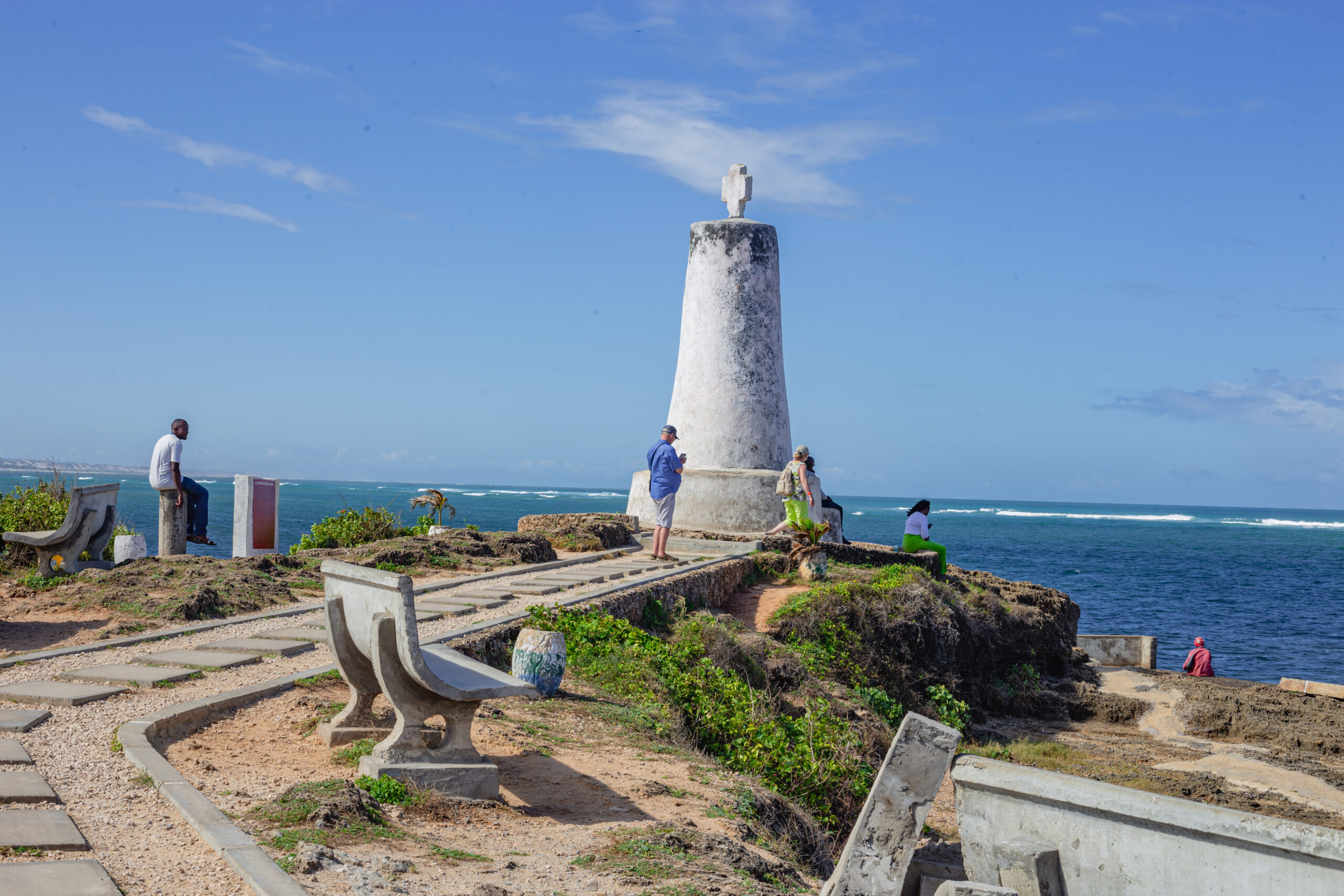
3. Vasco da Gama Pillar: A historic monument erected by Portuguese explorer Vasco da Gama in 1498, offering stunning views of the harbor. We visited this place and took some photos. I am not really sure why it’s a historical thing really, because it is said that Vasco da Gama did not come down from his ship, but at least I got some good photos and you too can when you visit.
4. Gede Ruins: An ancient Swahili settlement with ruins dating back to the 12th century, showcasing the region’s rich cultural heritage. We have always read about Gede ruins but have never visited until we moved to Malindi. Gede is such an amazing reminder of what Africa was before the unkind disruption that came with the Europeans and the subsequent evil that followed.
5. Watamu Beach: A picturesque beach with white sandy shores and crystal-clear waters, perfect for relaxation and water sports.
6. Hell’s Kitchen (Marafa Depression): A unique geological formation with breathtaking views, featuring a depression carved out by wind and water erosion.
7. Bio-Ken Snake Park: A research center and reptile sanctuary, home to a wide variety of snakes, tortoises, and other animals.
8. Falconry of Kenya: A private zoo and bird sanctuary, offering visitors the opportunity to see birds of prey and other animals up close.
9. Ndoro Sculpture Garden: A beautiful garden featuring sculptures and artwork, surrounded by lush vegetation and tranquil atmosphere.
10. Prawn Lake: A scenic lake with a variety of birdlife and a chance to spot crocodiles and other wildlife.
11. Mida Creek: A mangrove forest ecosystem, offering a unique and peaceful experience, with opportunities for birdwatching and boat tours.
All parts of Africa are beautiful in their own unique ways and each culture, though varied, tells one story of the greatness, resilience and wealth of the African people.
Watch the video we did about Gedi ruins: